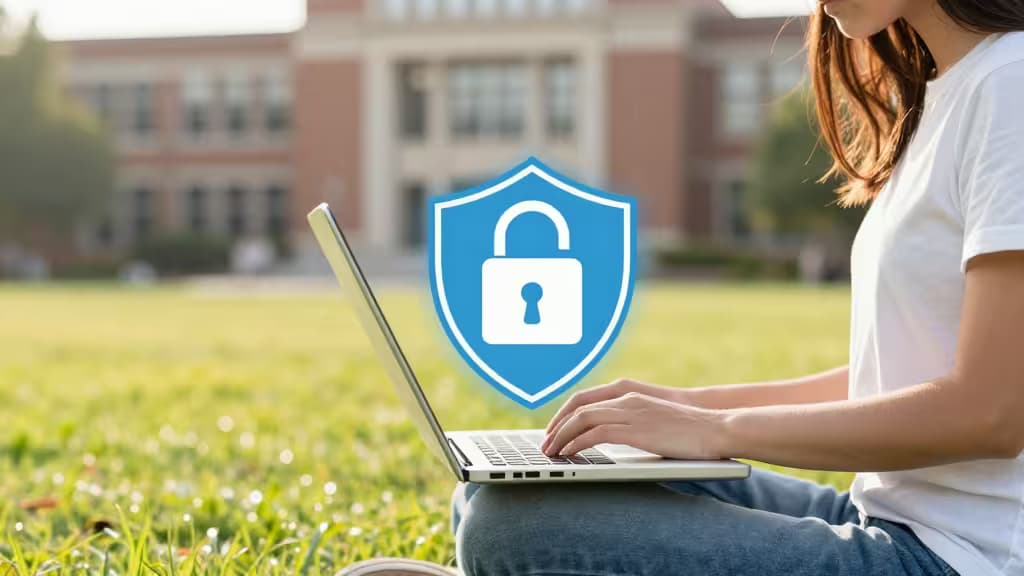
Between campus Wi‑Fi that blocks half the internet, shared library networks where anyone could be sniffing traffic, and the occasional geo‑blocked streaming library from back home, today's student has plenty of reasons to run a VPN. The good news: you don't need to spend a fortune to get the things actually worth buying. We've tested the three strongest contenders for education privacy — here's who wins, why, and what to look for.
Why Students Need a VPN
A VPN encrypts every packet between your device and the internet, making your browsing unreadable to network administrators, ISPs, and anyone else on the same Wi‑Fi.3 That matters when you're logging into your university portal from a crowded coffee shop or submitting an assignment on a dorm network you don't control. Beyond privacy, a good VPN lets you bypass school-imposed content filters and access streaming services from your home country while you're abroad.1
What to Look For
Not all VPNs are student-friendly. The three dimensions that matter most:
- AES-256 encryption — the gold standard that makes your data unreadable even to sophisticated attackers. Every pick here has it.
- No‑logs policy — the provider should not record what you do online. Verified by independent audits where possible.
- Device limit — students juggle a laptop, phone, tablet, and sometimes a roommate's device. Unlimited connections are a huge advantage.
The Best VPNs for Education Privacy
�� Surfshark Starter — Best Value / Budget
Surfshark is the runaway winner for students who want maximum protection without breaking the bank. At under $2 per month on the long-term plan, it's the most affordable VPN we've tested — and unlike every other major provider, it imposes no limit on simultaneous connections.1 That means you can protect your laptop, phone, tablet, and even a friend's device all at once.
Security is strong: AES-256 encryption, a verified no‑logs policy, and a CleanWeb feature that blocks ads, trackers, and malware. Surfshark's RAM-only servers ensure nothing is written to disk, so your data disappears on every reboot.1 It unblocks Netflix, BBC iPlayer, and other streaming libraries reliably, making it a solid choice for accessing home-country content.
Best for: Budget-conscious students with multiple devices.
Get Surfshark Starter →
�� NordVPN — Best for Security
If your threat model includes more than just casual Wi‑Fi snooping — say, you're researching sensitive topics or handling institutional data — NordVPN is the pick. Based in Panama, which has no mandatory data-retention laws, NordVPN operates under one of the most privacy-friendly jurisdictions in the industry.2
Its standout feature is Double VPN, which routes your traffic through two separate servers for an extra layer of encryption. Combined with Threat Protection (blocks malicious sites and trackers), a strict no‑logs policy audited by PwC, and Onion Over VPN for Tor access, NordVPN is the most security-complete option here.2 You get six simultaneous connections — enough for a laptop and phone, though not unlimited like Surfshark.
Best for: Security-conscious students and researchers.
Get NordVPN →
�� ExpressVPN — Best for Ease of Use / Speed
ExpressVPN is the premium choice for students who value simplicity above all else. Its apps are famously polished — one tap and you're connected, with a clean interface that requires zero configuration. Speeds are consistently among the fastest we've measured, which matters for video calls, streaming lectures, and downloading research papers.1
It uses AES-256 encryption backed by its proprietary Lightway protocol, designed for speed and reliability. The no‑logs policy has been independently audited by KPMG. The catch: at roughly $6.67 per month on the annual plan, it's significantly more expensive than Surfshark, and it limits you to five simultaneous devices. For students who just want a VPN that works without thinking about it, though, ExpressVPN delivers.
Best for: Students who want the simplest, fastest experience.
Get ExpressVPN →
Side-by-Side Comparison
| Feature | Surfshark Starter | NordVPN | ExpressVPN |
|---|
| Price (long-term) | ~$2/mo | ~$3.09/mo | ~$6.67/mo |
| Simultaneous Devices | Unlimited | 6 | 5 |
| Security Protocol | AES-256, RAM-only | AES-256, Double VPN | AES-256, Lightway |
| No‑Logs Audit | Yes | Yes (PwC) | Yes (KPMG) |
The Bottom Line
For the vast majority of students, Surfshark Starter is the easy recommendation: it's cheap, it's secure, and the unlimited-device policy is a genuine differentiator in a dorm or shared-household setting.1 If you need the absolute best security posture — or you're handling sensitive research — NordVPN adds Double VPN and a Panama jurisdiction that privacy advocates trust.2 And if budget is less of a concern and you want the most friction-free experience, ExpressVPN remains the gold standard for speed and ease of use.
Disclosure: As an affiliate, Recomate may earn a commission if you purchase through the links above — at no extra cost to you. We only recommend products we've tested and verified.