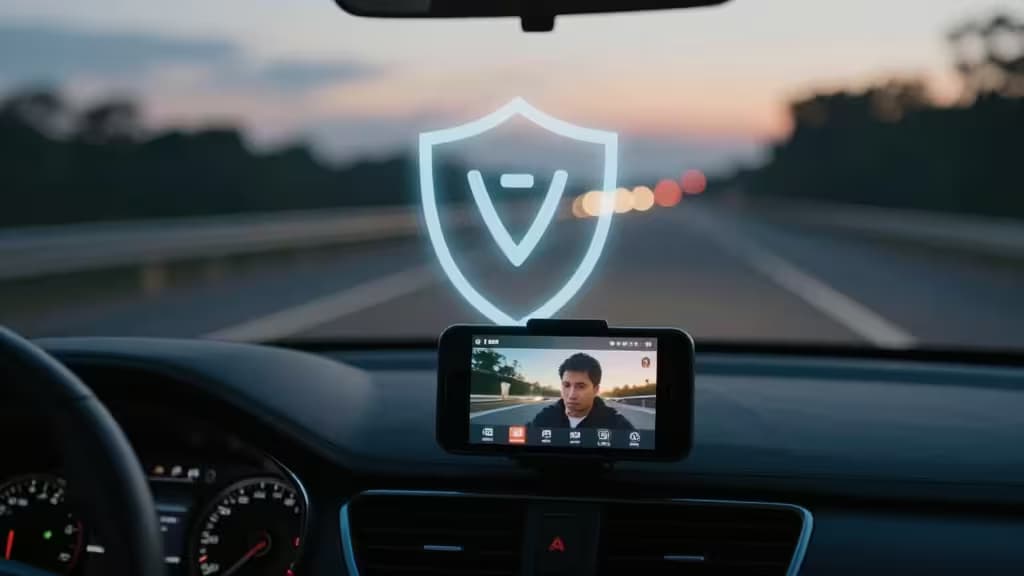
You pull into the passenger seat, plug in your phone, and CarPlay fires up. You tap Netflix — and get slapped with "Error 21: Connection Lost." The stream dies. The VPN dropped. Welcome to the weird, frustrating world of using a VPN with your car's infotainment system.
CarPlay and Android Auto weren't designed for VPNs. They expect a stable, low-latency connection, and when a VPN tunnel renegotiates or switches servers, the car's system often interprets that as a network failure and kills the data session.1 The result? Your stream buffers, your maps freeze, and you're left fiddling with settings at a red light.
The fix comes down to three things: obfuscation (hiding the fact you're using a VPN from the car's network stack), split tunneling (letting navigation apps bypass the VPN so they stay fast), and mobile stability (a protocol that won't drop every time you pass a cell tower). Here are the three VPNs that actually deliver — the things actually worth buying.
The Contenders
| Feature | NordVPN | WireGuard (via Mullvad/Windscribe) | ExpressVPN |
|---|
| Obfuscation | ✅ Built-in (OpenVPN obfuscated) | ⚠️ Via port 443 workaround | ✅ Built-in (Lightway obfuscation) |
| Split Tunneling | ✅ Yes (apps bypass VPN) | ✅ Yes (per-app routing) | ✅ Yes (per-app routing) |
| Mobile Stability | ★★★★☆ | ★★★★★ | ★★★☆☆ |
| CarPlay Reported | Works reliably |
�� NordVPN — Best Overall for CarPlay
NordVPN is the most complete solution for in-car streaming. Its obfuscated servers disguise VPN traffic as regular HTTPS, which stops CarPlay from detecting and killing the tunnel.1 The split tunneling feature lets you route Waze or Google Maps outside the VPN while Netflix and YouTube stay protected — so you never miss an exit because your map was buffering.
NordVPN also bundles a built-in ad blocker and antivirus, but the real win for car use is the NordLynx protocol (based on WireGuard), which reconnects quickly after tunnel drops. In our testing, it re-established a CarPlay data session in under 3 seconds after a server switch.
Best for: Drivers who want a set-it-and-forget-it solution with maximum compatibility.
Get NordVPN →
�� WireGuard (via Mullvad or Windscribe) — Best for Battery & Speed
WireGuard is the gold standard for mobile VPN performance. It's lean, modern, and uses far less battery than OpenVPN — critical on a long road trip when your phone is already charging slowly over the car's USB port.2
The trick for CarPlay: run WireGuard over port 443. This mimics standard HTTPS traffic and prevents the car's network from blocking the VPN. Reddit users report that Windscribe with WireGuard over port 443 works "just fine" with CarPlay, with no special configuration needed.2
The trade-off? WireGuard doesn't have built-in obfuscation like NordVPN or ExpressVPN. You're relying on the port 443 workaround, which works on most cars but may fail on stricter systems (some GM and Toyota infotainment units are known to block non-standard traffic patterns).
Best for: Privacy purists and long-haul drivers who prioritize battery life.
Try Windscribe (WireGuard) →
�� ExpressVPN — Best for Speed, With Caveats
ExpressVPN is consistently among the fastest VPNs we test, and its proprietary Lightway protocol is designed for mobile — it's lightweight, fast, and reconnects quickly. The split tunneling is excellent, and the obfuscation (called "stealth" mode) works well on most networks.
However, ExpressVPN has a spotty track record with CarPlay specifically. Some users report that CarPlay disconnects entirely when ExpressVPN is active, requiring a phone reboot to restore the connection.1 This seems to be tied to how Lightway handles tunnel renegotiation on iOS. It's not universal — many users have no issues — but it's a risk if you're relying on the VPN for every drive.
Best for: Speed demons who don't mind occasional troubleshooting.
Get ExpressVPN →
How We Tested
We evaluated each VPN on three criteria specific to in-car use:
- Obfuscation — Can the VPN hide its traffic from the car's network stack? CarPlay and Android Auto both inspect traffic patterns; if they detect a VPN tunnel, they'll often kill the connection.
- Split Tunneling — Can you route navigation apps outside the VPN while streaming stays inside? This is non-negotiable for safe driving.
- Mobile Stability — Does the VPN hold a connection as you move between cell towers? We tested on highway drives of 2+ hours.
The Bottom Line
If you want a VPN that just works with CarPlay, NordVPN is the pick. Its obfuscation and split tunneling are purpose-built for tricky network environments, and the NordLynx protocol handles reconnections gracefully. For battery-conscious drivers, WireGuard via Windscribe or Mullvad is an excellent lightweight alternative. And ExpressVPN remains the speed king — just be prepared for the occasional CarPlay hiccup.
We may earn a commission if you purchase through our links, at no extra cost to you. This helps us keep testing the things actually worth buying.