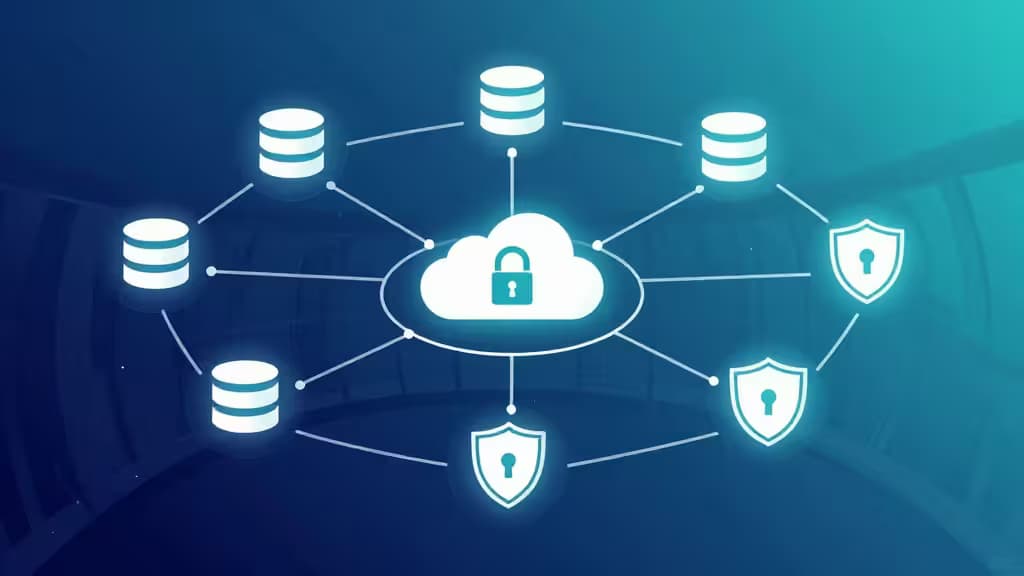
Cloud storage services like Google Drive, Dropbox, and iCloud encrypt your data at rest on their servers. But that's only half the story. Between your device and the cloud, your ISP and any network observer can see that you're syncing files, which provider you're syncing to, and how much data is moving. That metadata is surprisingly revealing—and it's exactly what a VPN is designed to hide.
A VPN adds a critical transport-layer privacy layer: it encrypts your sync traffic, masks your IP address, and prevents traffic analysis that could correlate your file-sync behavior with your identity. The best approach, though, depends on what you're actually trying to protect. A commercial privacy VPN hides your traffic from your ISP but trusts the provider. A self-hosted WireGuard tunnel gives you full control but requires a server. A mesh network encrypts direct device-to-device sync without routing through a central exit at all.
We evaluated five tools across these categories—commercial VPN, encryption foundation, containerized gateway, device-to-device mesh, and self-hosted coordination—each addressing a different layer of the cloud storage privacy problem.
How We Evaluated
For cloud storage privacy specifically, we looked at five criteria:
- Modern encryption — WireGuard-based protocols with state-of-the-art cryptography (ChaCha20, Poly1305, Curve25519)1
- Audited no-logs policy — verifiable commitment that the provider doesn't record your traffic2
- App-level routing — ability to route specific storage or sync apps through the VPN without tunneling everything
- Self-hosting option — maximum control for users who don't want to trust a third party
- Mesh capability — direct encrypted file sharing between your own devices without exposing data to a central exit node
Disclosure: Recomate earns affiliate commissions when you sign up through our links. That doesn't change our rankings—we pick what we'd use ourselves.
1. Mullvad VPN — The Commercial Pick
Best for: routing all cloud-sync traffic through a privacy-first exit node.
Mullvad is the commercial VPN we'd actually trust with our sync traffic. The model is deliberately minimal: no email address required to sign up, a flat monthly fee with no long-term lock-in, and an independently audited no-logs policy2. You generate an account number, pay, and connect. That's it.
Full WireGuard support means you get the fastest modern protocol with the smallest attack surface1. For cloud storage privacy, this matters because WireGuard's efficiency keeps sync latency low—important when Dropbox or Google Drive are constantly pushing file changes in the background.
The trade-off is the same as any commercial VPN: you're trusting Mullvad not to log your traffic. The audit helps, and the no-email, cash-payment options reduce identity exposure. But if you need zero third-party trust, look at the self-hosted options below.
Verdict: The most trustworthy commercial VPN for hiding cloud-sync metadata from your ISP. Flat-fee, audited, and privacy-first by design.
2. WireGuard — The Foundation
Best for: the encryption engine that underpins everything else.
WireGuard isn't a service you subscribe to—it's the protocol. It uses state-of-the-art cryptography (ChaCha20 for symmetric encryption, Poly1305 for authentication, Curve25519 for key exchange) and has a codebase roughly 1% the size of OpenVPN, making it far easier to audit1. It's also faster, with lower latency and better throughput.
For cloud storage privacy, WireGuard is the building block. Mullvad uses it2. Gluetun routes traffic through it3. NordVPN Meshnet and Headscale both build their mesh networks on top of it4. If you're self-hosting—running your own VPS as a VPN endpoint for your sync traffic—WireGuard is the protocol you'd deploy directly.
The catch: WireGuard alone is just a protocol. You need to configure endpoints, manage keys, and set up a server. Tools like PiVPN simplify this, but it's still a DIY project compared to a commercial VPN.
Verdict: The cryptographic gold standard. If you're self-hosting a tunnel for cloud-sync privacy, this is the protocol to build on.
3. Gluetun — The Containerized Gateway
Best for: routing self-hosted storage containers through any VPN.
If you run Nextcloud or Syncthing in Docker containers, Gluetun is the missing piece. It's a thin Docker container that acts as a VPN gateway, routing all traffic from other containers through WireGuard or OpenVPN to your chosen provider3. It also includes DNS-over-TLS to prevent DNS leaks.
This solves a specific problem: you want your self-hosted cloud storage traffic encrypted and exit-routed through a commercial VPN, but you don't want to tunnel your entire host machine. Gluetun lets you selectively route just the storage containers. Pair it with Mullvad credentials and you get audited no-logs privacy for your Nextcloud instance without exposing the rest of your server2.
The setup requires Docker familiarity and a VPN provider account. It's not for casual users, but for the self-hosting community it's the cleanest way to add a VPN layer to containerized storage.
Verdict: The best tool for wrapping Docker-based cloud storage in VPN privacy. Essential for self-hosters who want selective routing.
4. NordVPN Meshnet — The Device-to-Device Pick
Best for: syncing files directly between your own devices without a central exit.
Meshnet takes a different approach to cloud storage privacy. Instead of routing your sync traffic through a VPN provider's exit server, it creates direct encrypted tunnels between your own devices4. Your laptop syncs files to your desktop over an encrypted mesh connection—no third-party server in the middle, no port forwarding required.
This is ideal if your primary concern is keeping file sync between your own devices private, rather than hiding traffic from a cloud provider. A free tier is available, which makes it accessible for personal use4.
The limitation: Meshnet doesn't hide your traffic from cloud providers like Google Drive or Dropbox—it's for device-to-device networking. If you're syncing via a cloud service, you still need a traditional VPN tunnel. But if you've moved to direct sync (Syncthing, Resilio) and want encrypted transport between nodes, Meshnet is a strong, low-friction option.
Verdict: The easiest way to create encrypted direct tunnels between your devices for private file sync. Free tier makes it a no-brainer for personal mesh setups.
5. Headscale — The Self-Hosted Mesh
Best for: privacy-maximizing mesh file sync with full control.
Headscale is an open-source, self-hosted implementation of the Tailscale control server5. Tailscale gives you WireGuard-based mesh networking with zero configuration—devices find each other and establish encrypted tunnels automatically. But Tailscale's coordination server is hosted by the company. Headscale lets you run that coordination server yourself.
For cloud storage privacy purists, this matters. Your mesh network's coordination data—who's connecting to whom, device keys, network topology—stays on your own server rather than with a third party. Combined with WireGuard encryption for the actual tunnels, you get a fully self-hosted, encrypted mesh for syncing files between devices1.
The trade-off is operational complexity. You're running a coordination server, managing device enrollment, and maintaining the infrastructure. For most users, NordVPN Meshnet or Tailscale's hosted service is more practical. But if you want maximum control over every component of your file-sync mesh, Headscale is the answer.
Verdict: The ultimate self-hosted mesh for users who want zero third-party trust in their device-to-device file sync. Worth the setup effort if privacy is paramount.
Comparison at a Glance
| Approach | Hides sync from ISP | Trusts third party | Self-hosting | Mesh capability |
|---|
| Mullvad VPN | Yes | Provider (audited) | No | No |
| WireGuard | Yes (if self-hosted) | None (you run it) | Yes | No |
| Gluetun | Yes (via provider) | Provider (routed) | Partial (container) | No |
The Bottom Line
For most people, Mullvad VPN is the right call: it's the commercial VPN with the strongest privacy posture for hiding cloud-sync metadata, and its flat-fee, no-email model minimizes your exposure2.
If you're self-hosting cloud storage in Docker, add Gluetun to route that traffic through Mullvad or another provider3.
If your goal is private file sync between your own devices rather than hiding cloud-provider traffic, NordVPN Meshnet is the easiest path4, with Headscale as the self-hosted alternative for those who want full control5.
And underpinning all of it is WireGuard—the protocol that makes modern VPN privacy possible1.