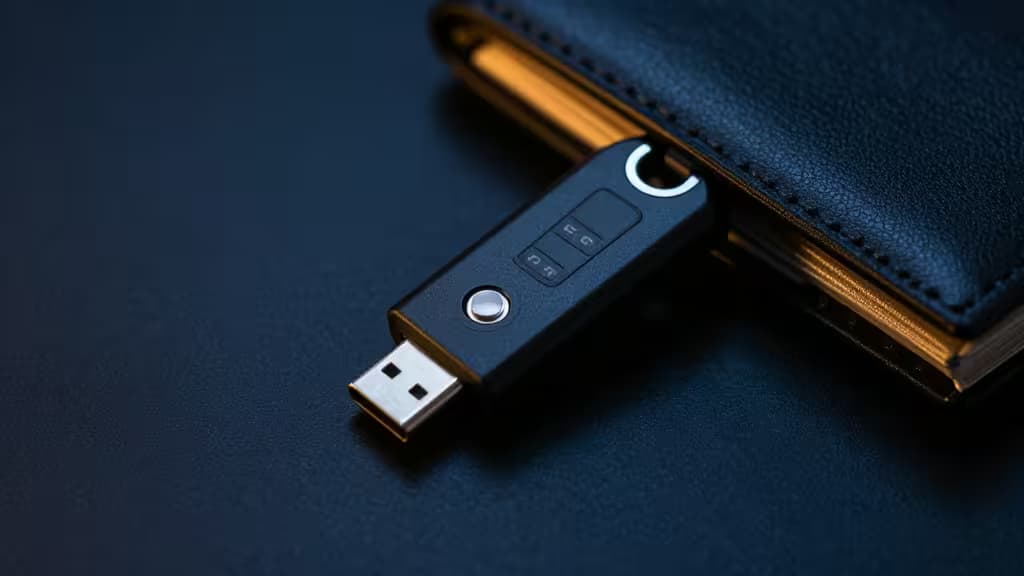
If you hold cryptocurrency on an exchange, your biggest threat isn't a blockchain exploit — it's a phishing page that harvests your credentials, or a SIM-swap attack that intercepts your SMS-based two-factor authentication. Hardware security keys using the FIDO2/WebAuthn standard stop both attack vectors cold by cryptographically binding each login to the legitimate domain, making phishing impossible.
A hardware wallet protects your private keys. A hardware security key protects the accounts that gate access to your exchange balances, email, and recovery flows. You need both. Here are the things actually worth buying in 2026.
Why Hardware Security Keys Matter for Crypto
SMS-based 2FA is the weakest link in most exchange account setups. SIM-swap attacks — where an attacker convinces your carrier to port your number to a device they control — bypass SMS codes entirely. App-based authenticators (Google Authenticator, Authy) are stronger but still vulnerable to phishing: a convincing fake login page can capture both your password and your one-time code in real time.
FIDO2/WebAuthn hardware keys solve this at the protocol level. When you tap a key to log in, the browser sends the actual domain name to the key, which signs a challenge that only the legitimate site can verify. A phishing page at binance-secure-login.com will never receive a valid response from your key, because the domain doesn't match. This is what security professionals mean by "phishing-resistant" — it's not a marketing term, it's a cryptographic guarantee.
Major crypto exchanges including Binance, Coinbase, Kraken, and Gemini support FIDO2 security keys as a 2FA method. The keys profiled below all implement the FIDO2/WebAuthn standard that these exchanges rely on.
How We Evaluated
We compared each key across five dimensions that matter for crypto users:
- Protocol support — FIDO2 is the baseline; additional protocols (U2F, OpenPGP, Smart Card, OTP) add versatility for power users.
- Form factor — USB-A, USB-C, and NFC determine which devices you can use the key with. More options mean broader compatibility.
- Durability — Crypto users who travel or store keys in safes need keys that survive water, crushing, and temperature extremes.
- Price band — Most users should own at least two keys (primary + backup). Lower cost makes that practical.
- Exchange compatibility — Broader protocol support and brand recognition translate to better out-of-the-box support on crypto platforms.
Our Picks
1. YubiKey 5 Series — Top Pick
The YubiKey 5 Series is the industry-standard multi-protocol security key, supporting FIDO2, U2F, Smart Card, OpenPGP, and OTP for comprehensive legacy and modern SSO integration.1 Available in USB-A, USB-C, and NFC form factors, it offers the broadest protocol coverage and exchange compatibility of any key we evaluated.
For crypto users, the multi-protocol support matters because it means the same key can secure not just your exchange accounts (via FIDO2) but also your email, password manager, and even SSH access to servers — all on one device. Yubico's dominance in the enterprise market means exchanges test against YubiKeys first, and you're unlikely to encounter compatibility surprises.
If you're buying one key to start, this is it. Buy two — one for daily use, one locked away as a backup — and register both on every exchange account.
2. Yubico Security Key Series — Budget Pick
Yubico's Security Key Series is a streamlined, FIDO-only key offering a cost-effective way to deploy phishing-resistant MFA.2 It supports FIDO2/WebAuthn, is water- and crush-resistant, and includes enterprise serial numbering for inventory management.
By dropping OpenPGP, Smart Card, and OTP support, Yubico brings the price down significantly while retaining the FIDO2 functionality that crypto exchanges actually require. If your sole use case is securing exchange and email accounts — and you don't need the advanced protocols — the Security Key Series delivers the same phishing-resistant authentication at a lower cost.
This is the key to buy in bulk: one for your daily carry, one for your safe, one for a trusted family member who might need emergency access. The water and crush resistance means you can store a backup in less-than-ideal conditions without worry.
3. Feitian ePass FIDO2 — Value Alternative
The Feitian ePass FIDO2 is a scalable, FIDO2-compliant security key designed for large-scale enterprise deployments and passwordless authentication.3 It supports FIDO2 and U2F with cross-platform compatibility and bulk deployment options.
Feitian is Yubico's most significant competitor, and the ePass line typically undercuts Yubico on price while maintaining FIDO2 compliance. For crypto users who need multiple backup keys — perhaps one stored at home, one at the office, one with a lawyer — the lower per-unit cost makes comprehensive redundancy affordable.
The trade-off is narrower protocol support (FIDO2/U2F only, no OpenPGP or Smart Card) and less brand recognition, which can occasionally mean slower support rollouts on niche platforms. For mainstream exchanges, though, FIDO2 is FIDO2 — the standard doesn't care who made the key.
4. Kensington VeriMark NFC+ — Windows-Focused Pick
The Kensington VeriMark NFC+ is an enterprise-grade FIDO2 security key that integrates deeply with Windows Hello for Business and centralized identity providers.4 It supports FIDO CTAP2.1 with NFC and USB-C connectivity.
If your crypto workflow runs primarily on Windows — desktop trading, Windows-based node operations, or corporate-managed devices — the VeriMark NFC+ offers the tightest Windows Hello integration of any key in this lineup. The CTAP2.1 support also brings additional security features like user verification enhancements over older CTAP versions.
The limitation is narrower appeal outside the Windows ecosystem. macOS and Linux users won't benefit from the Windows Hello integration, and the USB-C/NFC-only form factor means no USB-A option for older machines. But for Windows-centric crypto holders, it's a well-engineered choice.
5. YubiKey 5 FIPS Series — High-Assurance Pick
The YubiKey 5 FIPS Series features FIPS 140-2 certified security keys designed for government and highly regulated industries requiring the highest level of assurance (AAL3), with NIST SP800-63B compliance.5
For high-net-worth crypto holders, institutional traders, or anyone operating under regulatory compliance requirements, the FIPS certification provides independently verified assurance that the key's cryptographic module meets federal standards. This matters if you're managing funds on behalf of others, operating in jurisdictions with specific security mandates, or simply want the highest level of third-party-validated security available.
The FIPS variant carries the same multi-protocol support as the standard YubiKey 5 Series — FIDO2, U2F, OpenPGP, and Smart Card — so you don't sacrifice functionality for certification. The premium is in the certification and audit trail, not in additional features.
How to Set Up a Hardware Key on Your Exchange
The setup process is similar across major exchanges:
- Buy at least two keys. If you lose your only key, you may face a lengthy account recovery process. Register a backup on every account.
- Navigate to security settings. On Binance, Coinbase, Kraken, or Gemini, look for "Security Key" or "FIDO2" under 2FA settings.
- Insert and tap. The exchange will prompt you to insert or tap your key. Follow the browser's FIDO2 dialog.
- Register your backup key. Repeat the process with your second key. Most exchanges allow multiple registered keys.
- Remove SMS 2FA. Once your hardware key is registered and tested, disable SMS-based 2FA to eliminate the SIM-swap attack surface.
The Bottom Line
A hardware wallet protects your private keys; a hardware security key protects the accounts that control access to your crypto. For most users, the YubiKey 5 Series is the right starting point — its protocol breadth and exchange compatibility are unmatched. If budget is a concern, the Yubico Security Key Series delivers the same phishing-resistant FIDO2 authentication at a lower price. And for those managing significant assets under regulatory scrutiny, the YubiKey 5 FIPS Series provides independently certified assurance.
Disclosure: Recomate may earn affiliate commissions when you purchase through links on this page. This does not influence our editorial assessments.