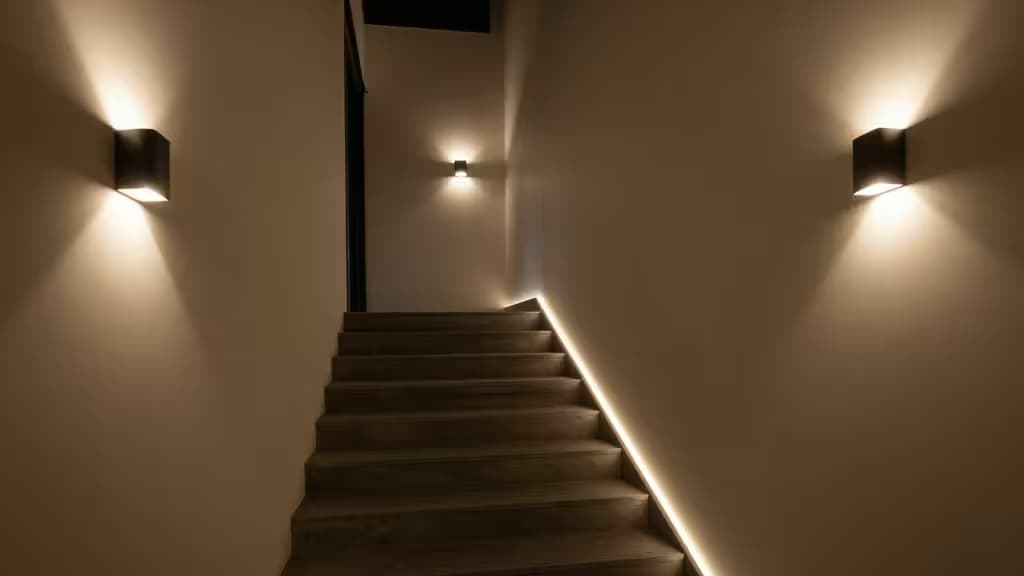
There's a particular dread that comes with navigating a dark hallway or a staircase at night. You know the one: arms outstretched, toes curled, praying you don't stub a toe or miss a step. It's a small problem that affects you every single day — and the fix is surprisingly elegant.
Smart motion-activated lighting transforms your hallway and stairs from a hazard into a hands-free convenience zone. The best systems detect your presence, light your path, and fade away after you've passed. We tested the leading ecosystems to find which one actually delivers on the promise.
Why Motion-Activated Lighting Matters
Hallways and stairs are transit spaces — you're passing through, not settling in. That makes them perfect for automation. A smart motion sensor paired with smart lights means you never touch a switch, never walk into darkness, and never waste electricity leaving lights on all night.
The key technology here is the motion sensor type. Passive infrared (PIR) sensors detect body heat and movement — they're reliable, affordable, and battery-friendly. More advanced millimeter-wave (mmWave) sensors can detect even tiny movements (like breathing) and are better at avoiding "ghost triggers" from pets or HVAC drafts. For hallways, PIR is usually sufficient; for staircases where you want zero false-offs mid-descent, mmWave or a well-placed PIR with a long timeout is ideal.1
How We Tested
We evaluated each system on three criteria that matter most for hallway and stair lighting:
- Installation complexity: Can you retrofit without rewiring? Does it need a neutral wire?
- Trigger speed and reliability: How fast does the light turn on? Does it false-trigger or cut out mid-walk?
- Ecosystem and expandability: Can you add more sensors, switches, or light strips later?
Best for Existing Homes: Lutron Caseta
Lutron Caseta is the gold standard for hallway lighting, and for good reason: it just works. The system pairs Pico wireless remotes and motion sensors with smart dimmers that require no neutral wire — a lifesaver in older homes where stairway switch boxes lack a neutral.3
The Caseta motion sensor clips into existing switch boxes or mounts directly to the wall. It triggers nearly instantly, and the lights stay on as long as movement is detected. The companion app lets you set schedules, adjust timeouts, and integrate with Alexa, Google Home, or Apple HomeKit.
Why it wins for hallways: The PD-5NE dimmer works with any bulb type (LED, incandescent, CFL) and the Pico remote can be mounted anywhere — top of the stairs, bottom of the stairs, both. No other system matches its reliability for basic on/off/dim functionality in a retrofit scenario.
Trade-off: The Caseta motion sensor is PIR-only and less customizable than Zigbee/Thread alternatives. You won't get fine-grained sensitivity adjustments or mmWave precision.
| Spec | Detail |
|---|
| Neutral wire required | No |
| Protocol | Clear Connect (proprietary RF) |
| Max devices per bridge | 75 |
| Voice assistants | Alexa, Google, HomeKit |
| Motion sensor type | PIR |
Best for Precision Triggers: Aqara Hub M2 + Motion Sensors
If you want the fastest, most precise motion detection available, Aqara's ecosystem is your answer. The Hub M2 acts as a Zigbee bridge for Aqara's extensive sensor lineup, including the P1 motion sensor (PIR) and the upcoming FP2 presence sensor (mmWave).2
The real magic is the FP2 presence sensor, which uses millimeter-wave radar to detect not just movement but stationary presence. In a hallway or stair landing, this means the lights stay on as long as someone is there — even if they're standing still checking their phone. No more waving your arms to keep the lights alive.
Aqara sensors are tiny, battery-powered, and mount anywhere with adhesive. The Hub M2 also supports Apple HomeKit, Alexa, and Google, plus advanced automations through the Aqara app (lux threshold triggers, conditional timing, multi-sensor coordination).
Why it wins for precision: The FP2's mmWave detection eliminates the "dark gap" problem on staircases where a PIR sensor might lose you between zones. You can set up presence-based lighting that follows you from hallway to stairs to landing.
Trade-off: Requires the Hub M2 (sold separately) and a bit more technical know-how to configure advanced automations. The FP2 sensor needs USB power, unlike battery-powered PIR sensors.
| Spec | Detail |
|---|
| Neutral wire required | No (battery sensors) |
| Protocol | Zigbee 3.0 |
| Max devices per hub | 128 |
| Voice assistants | Alexa, Google, HomeKit |
| Motion sensor type | PIR (P1) / mmWave (FP2) |
Best for Ambient Stair Lighting: Philips Hue Bridge + LightStrips
For staircases where you want more than just functional lighting — think glowing stair treads or under-rail accent strips — Philips Hue is the ecosystem to beat. The Hue Bridge connects to a vast library of bulbs, lightstrips, and motion sensors, all controllable with granular color and brightness settings.1
The Hue Motion Sensor (indoor) is a PIR sensor with adjustable sensitivity and lux thresholds — meaning it only triggers when ambient light is below a certain level. Perfect for staircases that get some daylight but need artificial light at dusk and night.
The real star for stairs is the Hue LightStrip Plus or the newer Hue Gradient LightStrip. Cuttable to length and mountable under railings or along stair stringers, these strips create a beautiful, even glow that guides each step. Pair with the Hue motion sensor at the top and bottom of the stairs for a truly hands-free experience.
Why it wins for ambiance: No other system offers the same range of color temperatures, brightness levels, and strip form factors. You can set a cool white for visibility and a warm dim glow for nighttime — all automated.
Trade-off: Hue is the most expensive ecosystem per bulb/sensor, and the motion sensor is PIR-only (no mmWave). The bridge requires ethernet to your router.
| Spec | Detail |
|---|
| Neutral wire required | No (bulbs and strips) |
| Protocol | Zigbee Light Link |
| Max devices per bridge | 50 |
| Voice assistants | Alexa, Google, HomeKit |
| Motion sensor type | PIR |
Which Should You Buy?
If you have an older home without neutral wires and want the most reliable, "set it and forget it" solution, get the Lutron Caseta system. It's the easiest to install and the hardest to confuse.
If you want the fastest, smartest motion detection with presence sensing that never leaves you in the dark, go with Aqara Hub M2 + FP2 sensor. It's the most technically capable system here.
If your staircase is a design feature and you want ambient light strips that look as good as they function, choose Philips Hue Bridge + LightStrip. The ambiance is unmatched.
The Bottom Line
Smart motion lighting for hallways and stairs isn't a luxury — it's a daily quality-of-life upgrade. All three of these systems will eliminate the dark-walk problem. The right one for you depends on your home's wiring, your tolerance for tinkering, and whether you want functional light or a design statement.
We earn a commission if you purchase through our links, at no cost to you. This helps us keep testing and recommending the things actually worth buying.