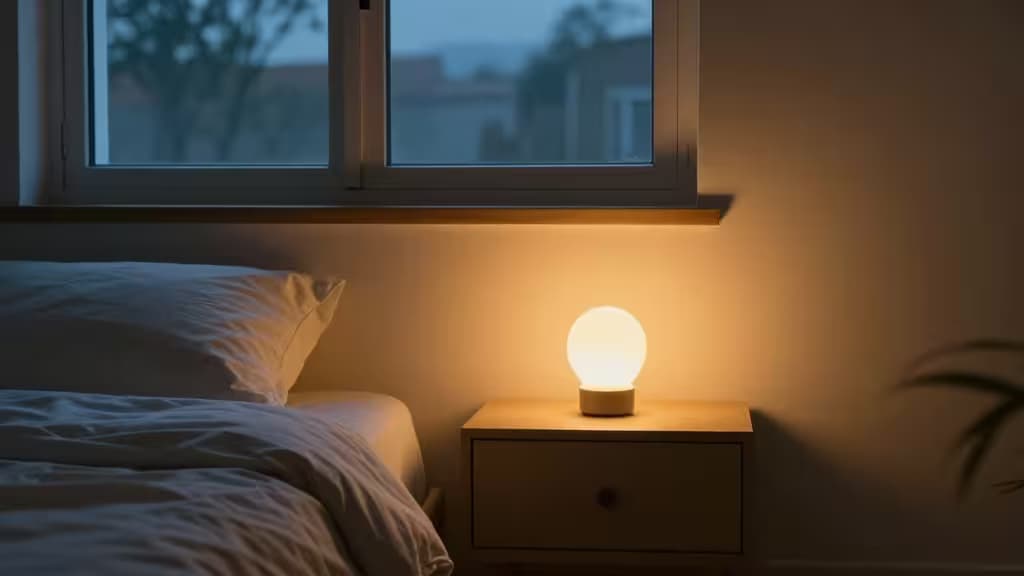
Your bedroom should be a sanctuary — the one room where the lighting works with your body, not against it. Harsh blue light at 10 p.m. suppresses melatonin; a dim, warm glow at 6 a.m. makes waking feel natural. The right smart bulb bridges that gap, and after combing through Wirecutter and How-To Geek's testing, we've found the four bulbs that do it best.1
We prioritized dimming quality at low levels (critical for reading in bed without blasting your partner), color-temperature range (warm 2200K for wind-down, cool 5000K for waking), and ease of control — because fumbling for your phone at 2 a.m. defeats the purpose.
Overall Premium: Philips Hue
The things actually worth buying for bedroom lighting start here. Philips Hue remains the gold standard for a reason: rock-solid reliability, a vast ecosystem of bulbs, switches, and sensors, and an app that makes scheduling effortless.2 The White & Color Ambiance bulb delivers a full spectrum from cozy candlelight (2200K) to energizing daylight (6500K), and the dimming curve stays smooth all the way down to 1% — no flicker, no sudden drop-off.
The catch? You need the Hue Bridge hub (Zigbee-based) for full functionality. That adds to entry cost, but it also means your lights respond instantly and stay connected even when Wi-Fi buckles. For a bedroom you'll rely on every night, that reliability is worth it.
Best for Sleep/Wake: WiZ 60W A19 Color
If you want circadian lighting without paying the Hue tax, WiZ is your answer. The WiZ 60W A19 Color LED has a built-in circadian-rhythm mode that automatically shifts color temperature throughout the day based on your actual sleep and wake schedule.1 Wirecutter calls it the best value in smart lighting, and we agree.
No hub needed — it connects directly over Wi-Fi — and the app includes preset routines like "Wake Up" (gradually brightening cool light) and "Sleep" (fading to a warm amber). The color saturation isn't as punchy as LIFX, but for bedroom-focused utility, this is the smarter buy.
Best for Apple Users: Meross MSL120
HomeKit integration is the killer feature here. The Meross MSL120 pairs directly with Apple Home for Siri voice control, automations ("Goodnight" scene = lights off, thermostat down), and away-from-home access — all without a separate hub.2
Response times are snappy (under a second), and the light distribution is notably even, with no visible hot spots even in lampshades. It lacks the color range of Hue or LIFX (it's tunable white only), but for the Apple household that just wants reliable, voice-controlled bedroom lighting, it's the cleanest path.
Best for Mood/Color: LIFX Color A19
When you want color — deep purples, saturated reds, vibrant aquas — LIFX is the bulb to beat. It delivers the most vivid, accurate colors of any smart bulb we've seen, with no hub needed (direct Wi-Fi).1 The LIFX app includes "Scenes" like "Sunset" and "Aurora" that cycle colors dynamically, perfect for transforming your bedroom into a mood-lit retreat.
The trade-off: LIFX bulbs are pricier than WiZ or Meross, and some users report occasional Wi-Fi reconnection lag. But for pure color quality and brightness (1,100 lumens — the brightest here), nothing else comes close.
How They Stack Up
| Feature | Philips Hue | WiZ 60W | Meross MSL120 | LIFX Color |
|---|
| Connectivity | Zigbee (hub) | Wi-Fi | Wi-Fi + HomeKit | Wi-Fi |
| Color Range | Full + tunable white | Tunable white + color | Tunable white only | Full + multizone |
| Dimming Quality | Excellent (1% floor) | Good (5% floor) | Good (5% floor) |
Why These Four?
A bedroom needs two modes: utility (reading, dressing, finding your phone) and atmosphere (winding down, romance, sleep hygiene). The Philips Hue covers both with unmatched polish. The WiZ is the pragmatic choice for circadian science on a budget. The Meross is the Apple-first shortcut. And the LIFX is for nights when you want your room to feel like a different world.
Recomate earns a commission if you purchase through the links above — it's how we keep the lights on (smartly, of course).