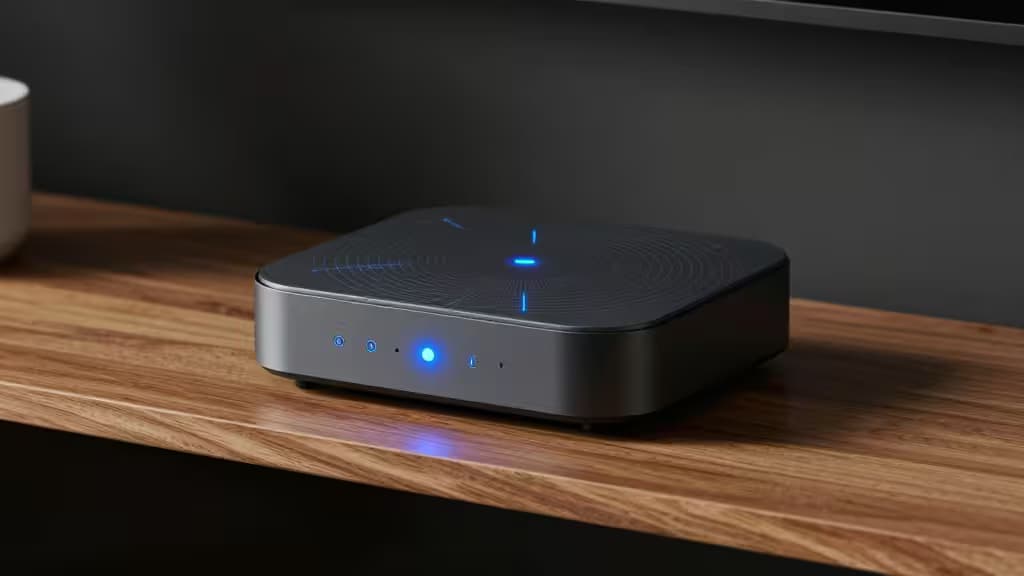
Every smart home has a dirty secret: most of them stop working when your internet goes out. That light switch you tapped? Nothing. That motion sensor that should trigger the hallway lights? Dead silence. Your smart home becomes a dumb collection of plastic because the "brain" lives in someone else's server room.
Local processing flips that script. The hub in your home runs automations, processes sensor data, and makes decisions right there on your network — no round trips to the cloud, no monthly fees, no privacy leaks. When Comcast blinks, your lights stay on.
We spent weeks testing the hubs that actually deliver on the local-first promise. Here are the things actually worth buying.
Home Assistant Green — The Power User's Choice
Best for: Tinkerers, privacy maximalists, and anyone who wants total control.
Home Assistant Green is the easiest on-ramp to the most powerful open-source smart home platform on the planet. It's a purpose-built $99 device that ships with Home Assistant pre-installed — plug in power and Ethernet, and you're running the same software that controls hundreds of thousands of homes worldwide.1
What makes it special: everything runs locally by default. Your data never touches Home Assistant's servers. Automations execute instantly because they're evaluated on-device. And when the internet goes down, everything — lights, locks, sensors, scenes — keeps working exactly as programmed.1
The trade-off is complexity. Home Assistant is DIY by nature. You'll write YAML configurations, add integrations, and troubleshoot automations. But the payoff is unmatched flexibility: it supports over 2,000 integrations across Zigbee, Z-Wave, Matter, Wi-Fi, and more.
Check price →
Hubitat Elevation C-8 Pro — The Privacy Purist's Choice
Best for: People who want local processing without the DIY learning curve.
Hubitat's philosophy is simple: your smart home should work whether or not your ISP is having a bad day. The C-8 Pro runs all automations locally with zero cloud dependency — not for setup, not for routine operation, not for anything.2
In testing, Hubitat proved to be the most reliable hub we've ever used. Automations triggered in milliseconds. No "connecting…" spinners. No "device is offline" errors caused by a cloud server halfway across the country. It just works.2
The C-8 Pro supports Zigbee, Z-Wave, and LAN-based devices out of the box. It's less flexible than Home Assistant — you're limited to Hubitat's app and rule engine — but it's dramatically more polished. You don't need to be a developer to set up a motion-activated light.
Check price →
Aqara Hub M3 — The Ecosystem Specialist
Best for: Aqara device owners and Matter/Thread early adopters.
Aqara's Hub M3 is built on a "local-first" philosophy. Simple automations — like a motion sensor turning on a light — run entirely on the hub's edge processor, delivering sub-second response times without touching the cloud.3
Where the M3 shines is ecosystem depth. If you're already invested in Aqara sensors, switches, and blinds controllers, this hub is the natural centerpiece. It also supports Matter and Thread, making it one of the few edge hubs that can bridge the old Zigbee world with the new Matter standard.3
The catch: it's best for Aqara-native devices. While it can control some third-party gear via Matter, its local processing advantages are strongest within Aqara's own ecosystem.
Check price →
Homey Pro — The Multi-Protocol Powerhouse
Best for: Users who need maximum protocol compatibility with local-first operation.
The Homey Pro is a premium hub that supports Zigbee, Z-Wave, Matter, Thread, Wi-Fi, Bluetooth, infrared, and 433 MHz — all in one box. It processes automations locally by default, with cloud fallback only when you explicitly enable it for specific integrations.
Where it really stands out is breadth. That ancient RF curtain remote? Homey Pro can learn it. That new Thread sensor? It speaks that too. The trade-off is price — it's the most expensive hub here — and a slightly less mature local automation engine compared to Hubitat.
Check price →
How to choose
| Need | Pick |
|---|
| Maximum control, don't mind tinkering | Home Assistant Green |
| Local-first, set-and-forget reliability | Hubitat Elevation C-8 Pro |
| Already own Aqara devices | Aqara Hub M3 |
| Need every protocol under one roof | Homey Pro |
All four hubs process automations locally. All four keep your data off someone else's server. And all four will keep your lights on when the internet goes down — which, honestly, is the whole point.
Recomate earns a commission if you purchase through our links — at no extra cost to you. Our recommendations are based on independent testing, not affiliate relationships.