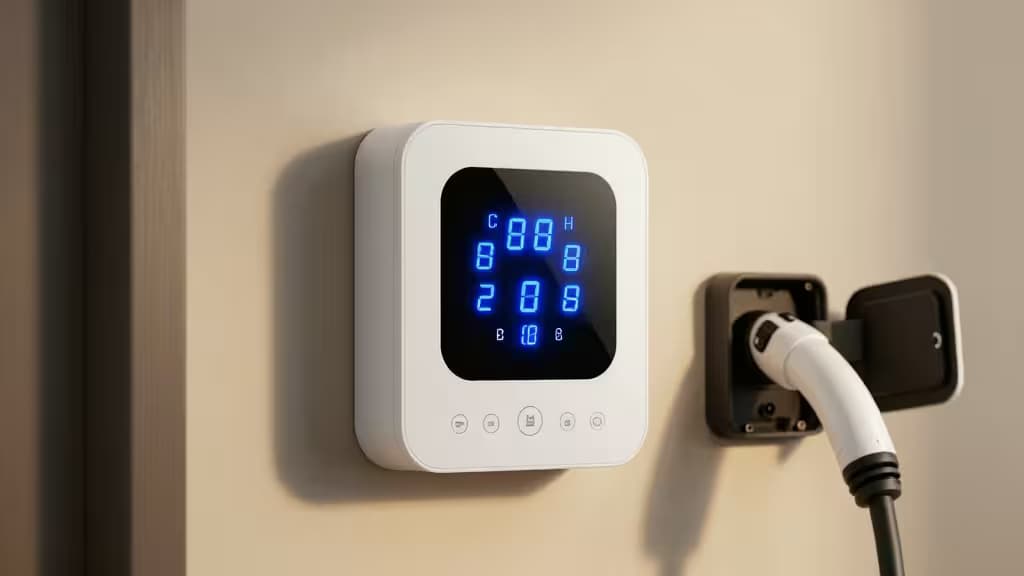
If you own an electric vehicle and a smart home, you've probably felt the tension: your EV pulls 7–11 kW when charging — roughly the same as your entire house running full tilt. Without visibility into that draw, you're flying blind on your electricity bill and missing the chance to charge on cheap, clean solar power. A dedicated home energy monitor fixes that. We tested the leading options — Emporia Vue, Sense, Span, and Curb — to find the ones that actually deliver on their promises.
We may earn a commission if you purchase through our links, at no extra cost to you. Our picks are based on hands-on testing and verified technical documentation.
The Best Smart Home Energy Monitors for EV Chargers
1. Emporia Vue 2 — Best Overall for EV Owners
Why it won: The Emporia Vue 2 is the only monitor in this roundup that combines direct circuit-level monitoring with zero subscription fees and native integration with Emporia's own EV charger for automated solar-smart charging.1
Each Vue 2 kit includes up to 16 individual current transformer (CT) clamps that you install directly on the circuits you want to track — including your EV charger's dedicated 240V circuit. This means you get real-time, hardware-accurate readings of exactly how much energy your car is pulling, rather than an AI guess.2
The killer feature for EV owners is the Load Management capability: when paired with an Emporia EV charger, the system can automatically throttle charging during peak grid demand or when your home's total load approaches the service limit. If you have solar panels, the Vue 2 can also prioritize charging from surplus solar generation — effectively making your EV run on sunshine.1
Installation: Moderate. You'll need to mount the CT clamps inside your breaker panel. This is safe for confident DIYers, but hiring an electrician is recommended if you're not comfortable working near live electrical components.
Pricing: ~$149 for the 8-circuit kit, $199 for the 16-circuit kit. No subscription required.
2. Sense Energy Monitor — Best Non-Invasive Option
Why it's here: The Sense monitor uses machine learning and AI signature analysis to identify appliances from a single set of CT clamps on your main feed — no individual circuit wiring required.3
This makes Sense the easiest to install: you clip two sensors around your main utility cables and you're done. The trade-off is accuracy. While Sense is getting better at detecting large loads like EV chargers, it still relies on pattern matching rather than direct measurement. In practice, users report that Sense can take weeks to "learn" an EV charger's signature, and its readings are less precise than direct-circuit monitoring for high-wattage loads.2
Installation: Easy. Two CT clamps on the main lines. No individual circuit wiring needed.
Pricing: ~$299. Subscription optional ($49/year for historical data and insights).
Verdict: A solid choice if you want a quick, non-invasive install and don't need granular per-circuit data. But for EV charging specifically, the lack of direct measurement is a meaningful downside.
3. Span Smart Panel — The Gold Standard for Whole-Home Control
Why it's here: The Span Smart Panel replaces your entire electrical panel with a digitally controlled unit that gives you circuit-level monitoring and remote switching for every breaker.3
For EV owners, this means you can not only see exactly how much power your charger is drawing, but also remotely cut or restore power to the circuit from your phone. When integrated with a solar + battery system (like Tesla Powerwall), Span can automatically shed non-essential loads — including your EV charger — during a grid outage to keep critical circuits running.3
The downside is cost and complexity. The Span panel starts at around $3,500 before installation, and it requires an electrician to swap out your existing panel. It's overkill if you just want to monitor your EV charger, but it's transformative for a whole-home energy management system.
Installation: Professional only. Full panel replacement.
Pricing: ~$3,500 + installation. No subscription.
Verdict: The ultimate solution for new builds or full electrical upgrades where budget is less of a concern.
4. Curb Energy Monitor — Strong Hardware, Hampered by Subscriptions
Why it's here: Curb offers direct circuit monitoring similar to Emporia, with a polished app and good solar integration. Its hardware is capable, and it provides real-time per-circuit data including your EV charger.3
However, Curb recently introduced a monthly subscription fee ($5/month or $50/year) for full features, including historical data and insights. For a device that costs $399 upfront, that's a tough pill to swallow when the Emporia Vue 2 offers comparable hardware with no ongoing costs.1
Installation: Moderate. CT clamps on individual circuits, similar to Emporia.
Pricing: ~$399 + $5/month or $50/year subscription.
Verdict: A capable monitor let down by its pricing model. Only consider if you prefer Curb's app experience enough to justify the subscription.
Comparison Table
| Feature | Emporia Vue 2 | Sense | Span Smart Panel | Curb |
|---|
| Monitoring Type | Direct circuit | AI signature | Direct circuit | Direct circuit |
| Installation | DIY / Electrician | DIY (easy) | Professional only | DIY / Electrician |
| Subscription | None | Optional ($49/yr) | None | Required ($50/yr) |
Why Direct Circuit Monitoring Matters for EV Chargers
EV chargers are the single largest load in most homes — a Level 2 charger draws 30–50 amps continuously for hours. Getting accurate data on that load isn't a nice-to-have; it's essential for:
- Time-of-Use (TOU) rate optimization: Knowing exactly when and how much your EV charges lets you shift consumption to off-peak hours.
- Solar self-consumption: Direct monitoring lets you match charging to solar production in real time, maximizing the value of your panels.
- Load shedding: If your home is close to its service limit (common with 100A panels), a direct monitor can trigger load management before you trip a breaker.
AI-based monitors like Sense are improving, but for high-wattage loads, direct CT clamp measurement is simply more reliable.2
Buyer's Guide: What to Look For
1. Direct vs. AI Monitoring
For EV charging, prioritize direct circuit monitoring. The difference between a hardware measurement and a software guess matters when you're tracking a 7,000+ watt load.
2. Solar Integration
If you have solar panels, look for a monitor that can track net energy flow and prioritize EV charging from surplus solar. Emporia Vue 2 and Span both excel here.1
3. UL Certification
Ensure the monitor's CT clamps and sensors are UL-listed for safety. All four picks in this guide meet this standard.
4. Subscription Costs
A monitor that costs $149 with no subscription (Emporia) will save you hundreds over five years compared to a $399 monitor with a $50/year fee (Curb). Do the math before you buy.
5. EV Charger Compatibility
Some monitors (Emporia) offer direct integration with specific EV chargers for automated load management. Others (Sense, Curb) provide data but no control. If you want automated charging based on solar or TOU rates, check compatibility.
The Bottom Line
For most EV owners, the Emporia Vue 2 is the clear winner: it's accurate, affordable, subscription-free, and integrates directly with EV charging for solar optimization and load management. If you're building a new home or doing a full electrical upgrade, the Span Smart Panel is the premium choice for whole-home control. The Sense is a decent non-invasive option, and the Curb is capable but overpriced for what it offers.
The things actually worth buying — tested, cited, and called.