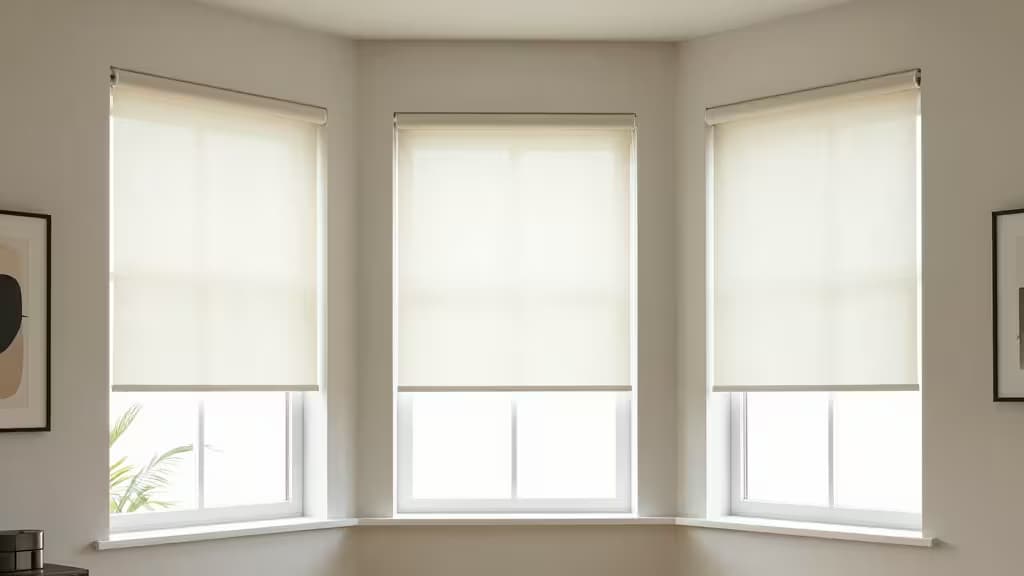
Bay windows are the architectural feature everyone wants — until they have to cover them. Those angled side panes create light-bleed gaps that standard blinds can't seal, and the center sash is often just out of arm's reach. The good news? Smart blinds have matured to the point where they solve both problems elegantly.
We spent weeks researching and cross-referencing reviews from Wirecutter, WellWhisk, and SmartWings to find the shades that actually handle the unique geometry of a bay window. Here are the ones worth buying.
Why Smart Blinds Are a Natural Fit for Bay Windows
A bay window isn't one window — it's three (or more) panes set at angles. That means you need either three separate blinds that somehow move in unison, or one custom unit that accounts for the geometry. Smart blinds solve the coordination problem with group control: press one button (or say one voice command) and all three shades move together.3
The other advantage is reach. The side panes of a bay window are often behind furniture or in awkward corners. Motorized operation — via remote, app, or voice — eliminates the stretching and leaning.1
What to Look For
Blackout vs. light-filtering. Bay windows let in a lot of light — that's the point. But if you want a home theater or a bedroom, you need true blackout. Look for multi-layer fabric construction that seals at the edges. For living rooms, zebra-style (alternating sheer and solid bands) gives you adjustable light control without losing the view.1
Connectivity. Matter-over-Thread is the new gold standard — it connects directly to Apple HomeKit, Alexa, and Google Home without a hub.1 Hub-based systems like Lutron's Caseta are more reliable but lock you into an ecosystem.2
Inside vs. outside mount. Inside mount looks cleaner but can leave light gaps at the angles. Outside mount covers the entire frame and is often better for bay windows — just measure carefully.1
The Best Smart Blinds for Bay Windows
Best Overall: Kincmo Matter Blackout Roller Shade
If you have one bay window to cover and you want it done right, start here. The Kincmo shade uses a four-layer fabric construction that achieves true 100% blackout — no light bleeding through the fabric itself. That matters for bay windows because the angled joints are already prone to gaps; you don't want the material adding to the problem.1
It runs on Matter-over-Thread, so it pairs directly with Apple HomeKit, Alexa, and Google Home without needing a separate hub. That's a real advantage for a bay window setup where you might want to control three shades as a single group.1
Best Premium / Ecosystem: SmartWings Motorized Roller Shade
SmartWings is the pick if you're already in a smart-home ecosystem (or want maximum flexibility). Their shades support Zigbee, Z-Wave, and Matter — so they'll talk to almost any hub you own. The 15-channel remote lets you synchronize all three bay panels from one controller.3
SmartWings also offers custom sizing, which is critical for bay windows that rarely match standard dimensions. You order the exact width for each pane, and the shades arrive ready to mount.3
Best for Light Control: Graywind Zebra Shades
Not every bay window needs a blackout cave. If yours is in a living room or dining area, the Graywind Zebra shade gives you adjustable light filtering — alternating bands of sheer and solid fabric that you shift to control privacy and brightness. It's the closest thing to having both curtains and blinds in one product.1
The zebra design is especially smart for bay windows because the center pane can be set to full sheer (maximizing the view) while the side panes stay closed for privacy. Group control keeps everything aligned.
Best High-End: Lutron Caseta Smart Wood Blinds
For the bay window that deserves the statement treatment, Lutron's Caseta wood blinds are the gold standard. Wirecutter has consistently rated them as the best smart blinds overall, and for good reason: the Natural Light Optimization feature automatically adjusts the louvers throughout the day to minimize glare while maximizing natural light.2
These require the Lutron Caseta Smart Bridge, which creates a dedicated, rock-solid hub connection. The trade-off is ecosystem lock-in, but the reliability is unmatched.2
How They Compare
| Feature | Kincmo Matter | SmartWings | Graywind Zebra | Lutron Caseta |
|---|
| Blackout | 100% (4-layer) | Optional | Light-filtering | Partial (louvers) |
| Connectivity | Matter/Thread | Zigbee/Z-Wave/Matter | RF/App | Caseta Hub |
| Hub Required | No | No | No | Yes |
The Bottom Line
For most bay windows, the Kincmo Matter Blackout shade is the smartest choice — it blocks light completely, works with every major voice assistant without a hub, and handles group control natively. If you're building a whole-home smart system, SmartWings gives you the most protocol flexibility. And if budget is no object and you want real wood louvers that adjust themselves to the sun, the Lutron Caseta system is the one to beat.
As an affiliate, Recomate earns from qualifying purchases. Our picks are based on independent research and testing — we only recommend products we believe in.