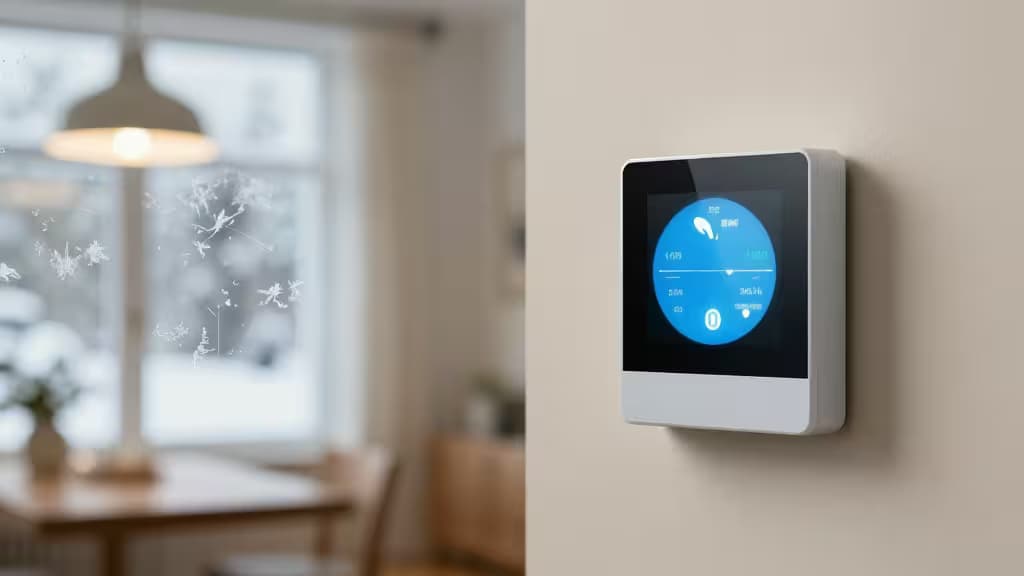
If you live somewhere the mercury regularly drops well below freezing, a smart thermostat isn't just a convenience gadget — it's a tool that can save you hundreds of dollars per heating season or quietly waste that same money running backup heat strips you don't need. The wrong model, paired with a heat pump, can kick on auxiliary electric heat far more often than necessary, ballooning your winter utility bills.
The key features that separate a genuinely useful cold-climate thermostat from a pretty wall display are: auxiliary heat lockout control (the ability to tell the system when to switch from the heat pump to expensive electric backup), heat pump compatibility, remote room sensors to combat cold spots in far corners of the house, and a C-wire workaround for older homes that lack the constant power wire modern thermostats expect.
We evaluated five leading models across these criteria, drawing on multi-season field testing1, Wirecutter's lab and long-term reviews2, and PCMag's hands-on testing3. Here's what we found.
Why Auxiliary Heat Lockout Matters So Much
When a heat pump can't keep up with demand — typically at very low outdoor temperatures — most systems fall back to electric resistance "auxiliary" heat. This is far less efficient and dramatically more expensive to run. A smart thermostat with granular aux heat lockout lets you set the exact outdoor temperature at which backup heat is allowed to engage, keeping the heat pump doing the work for as long as possible.
The difference is not theoretical. One Reddit user documented 148 hours of auxiliary heat runtime on a Nest versus just 27 hours after switching to an ecobee with properly configured lockout settings1. That's the kind of gap that translates directly into hundreds of dollars over a single winter.
Our Picks
1. ecobee Smart Thermostat Premium — Top Pick for Heat Pump Systems
The ecobee Smart Thermostat Premium is the thermostat HVAC professionals consistently recommend for cold-climate homes with heat pumps, and the reason comes down to control. Its auxiliary heat lockout is fully configurable — you set the exact outdoor temperature threshold, and the system respects it1. Nest, by contrast, caps its lockout at -12°C, which means in truly extreme cold the backup heat will engage sooner than many homeowners want1.
Beyond lockout, the Premium ships with one SmartSensor in the box, letting you monitor a cold bedroom or nursery from day one2. It also includes a built-in air quality monitor and smart speaker, making it the most feature-complete thermostat Wirecutter tested2. PCMag awarded it Editors' Choice at $259, noting broad platform support across Alexa, Google Home, HomeKit, IFTTT, and SmartThings3.
For cold-climate homeowners with heat pumps, this is the thermostat actually worth buying.
2. Google Nest Learning Thermostat 4th Gen — Best for Conventional Systems
If you have a conventional furnace setup rather than a heat pump, the Nest Learning Thermostat 4th Gen is arguably the smartest option on the market. Its adaptive learning algorithm studies your schedule and temperature preferences over time, building a program automatically — and Google claims up to 31% energy savings on heating1. The 4th Gen also includes a Nest Temperature Sensor in the box and supports Matter, broadening its smart-home compatibility1.
Wirecutter praised it as the smartest and easiest thermostat to set up2, and PCMag highlighted it as the best pick for AI-driven savings3. A "natural heating" feature even uses outdoor temperature data to preheat efficiently.
The caveat for cold climates: the aux heat lockout caps at -12°C, which is less granular than ecobee's approach1. For conventional systems this is a non-issue, but heat-pump owners in extreme cold should weigh the ecobee instead.
3. ecobee Smart Thermostat Enhanced — Best Mid-Range Value
The ecobee Enhanced delivers the same core heating intelligence and energy savings platform as the Premium — ecobee reports up to 26% savings — but trims a few premium features to land at a lower price point1. What you keep: radar-based occupancy sensing that can preheat the home before you arrive, and the Power Extender Kit (PEK) for homes without a C-wire, which ecobee says covers 90% of HVAC systems1.
Remote sensors aren't included in the box but can be added separately. If you want ecobee's excellent aux heat lockout control without paying for the air quality monitor and speaker, this is the sweet spot.
4. Honeywell Home T9 — Best for Multi-Room Monitoring
The Honeywell Home T9's standout feature is sheer sensor capacity: it supports up to 20 remote sensors with occupancy detection, far more than any competitor in this lineup3. For a large cold-climate home with uneven heating — a drafty addition, a finished basement, bedrooms on different floors — that means the thermostat can prioritize comfort in the room people are actually using.
PCMag named it best for remote room monitoring3. It offers broad HVAC compatibility including heat pumps, a responsive touchscreen interface, and dual-band Wi-Fi for reliable connectivity. The aux heat lockout is configurable, though not as granular as ecobee's system.
5. Sensi Smart Thermostat — Budget Pick
The Sensi Smart Thermostat is the entry point for homeowners who want smart features without the premium price tag. It's Energy Star certified with reported savings of up to 23%, and installation is designed to be DIY-friendly1. For some systems, no C-wire is required1. PCMag highlighted the Sensi ST55 as the best affordable HomeKit-compatible option3.
It works with Alexa, Google Home, and HomeKit, covering the major voice platforms. The trade-offs: no remote sensor support, and the aux heat lockout is more basic than what ecobee or Honeywell offer. For a straightforward conventional system in a moderately cold climate, though, it gets the job done at a fraction of the cost.
ecobee vs. Nest: The Cold-Climate Question
The most common cold-climate question is whether to choose ecobee or Nest. Both are excellent thermostats, but they diverge sharply on auxiliary heat management — the single most important factor for heat-pump owners in freezing conditions.
| Feature | ecobee Premium | Nest Learning 4th Gen |
|---|
| Aux heat lockout | Fully configurable | Capped at -12°C |
| Remote sensors | 1 included, up to 32 | 1 included |
| Built-in speaker | Yes | No |
| Air quality monitor | Yes | No |
| Adaptive learning | No | Yes |
| Reported savings | Up to 26% |
The Reddit-documented gap of 148 vs. 27 hours of auxiliary runtime1 is the clearest real-world evidence we've seen that ecobee's granular lockout pays off in cold climates. Nest's adaptive learning is genuinely impressive for conventional systems, but its lockout ceiling is a real limitation when temperatures plunge.
How We Evaluated
We drew on three primary sources: PWICE's multi-season cold-climate field testing that tracked real energy consumption and auxiliary heat runtime across eight models1; Wirecutter's comprehensive lab and long-term reviews, which named the ecobee Premium their top pick for best remote sensor performance and privacy2; and PCMag's hands-on testing, which awarded the ecobee Premium Editors' Choice and evaluated platform compatibility, sensor support, and value3.
Disclosure: Recomate earns affiliate commissions when you purchase through links in this article. Our editorial recommendations are based on the sources cited above, not on commission rates.