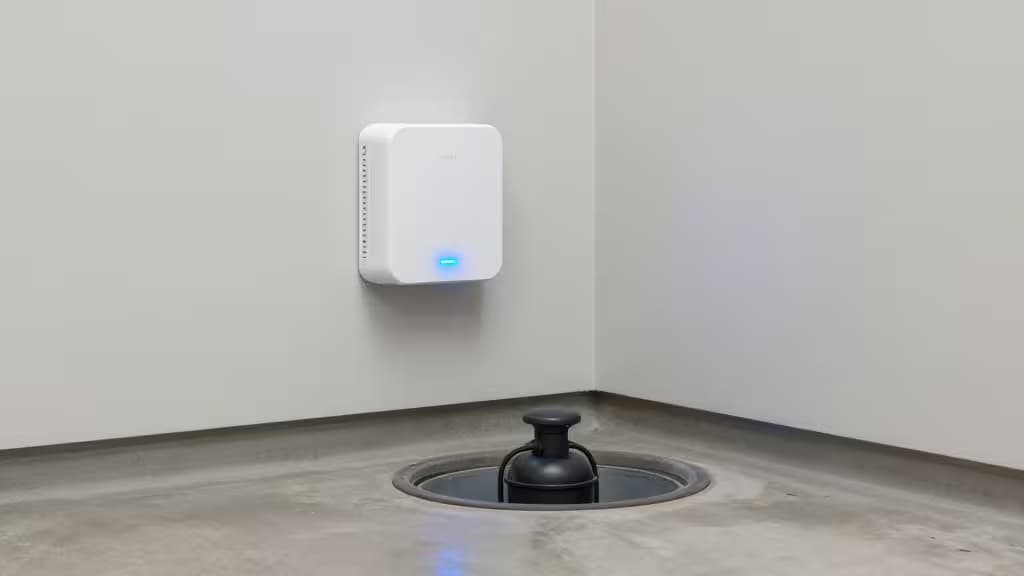
A sump pump is the silent workhorse of a dry basement — until it isn't. When the pump burns out, the power goes down, or the float switch jams, water can rise fast enough to ruin flooring, drywall, and stored belongings in a matter of hours. Smart Wi-Fi sump pump monitors exist to close that gap: they watch water levels, pump behavior, and power status, then push alerts to your phone before the situation becomes a disaster.12
We looked at five monitors that span the full range of approaches — from a sensorless plug-in that reads pump power consumption, to a multi-sensor environmental hub, to a premium system that physically tests your pump every morning. Here's how they compare, and which one fits your basement's risk level.
How We Evaluated
We drew on expert reviews from SmartHomeExplorer (which aggregates consensus scores across multiple review sites), buying guides from Best Home Tools and Home Upgrade Guide, and Wirecutter's testing of smart leak detectors.123457 The key questions we asked of each monitor:
- Does it detect water or test the pump? Detecting rising water is the baseline; physically cycling the pump is a higher bar that catches mechanical failure before water ever rises.
- What sensors does it include? Water level, leak detection, temperature, humidity, and power failure all matter in different scenarios.
- Is there backup power? A monitor that dies when the lights go out isn't much use during a storm.
- What's the subscription model? Some monitors charge monthly for cloud alerts; others include everything upfront.
- How hard is setup? Plug-and-play matters if you're not a plumber.
1. PumpFuse WiFi — Easiest Setup, No Sensors Required
Expert consensus: 7.8/10 | ~$79–99 | No subscription
The PumpFuse takes a fundamentally different approach from every other monitor here: it doesn't use water-level sensors at all. Instead, it plugs into the same outlet as your sump pump and monitors the pump's power consumption directly. An AI auto-calibration learns your pump's normal behavior within minutes, then flags anomalies — dry runs, overloads, rapid cycling, and power loss — as they happen.5
LWS Water called it "the simplest sump pump monitor on the market — plug in and connect to WiFi; no sensors, no logins, no subscriptions."5 That simplicity is the appeal: there's nothing to mount in a wet pit, no float switch to tangle, and no monthly fee. The trade-off is that PumpFuse can tell you the pump is misbehaving but can't independently confirm water level — if you want environmental data (temperature, humidity, leak detection on the floor), you'll need a complementary sensor.1
Best for: Homeowners who want affordable, zero-maintenance flood protection and trust that pump-behavior monitoring is enough warning.
2. Level Sense Pro — Most Sensor-Dense, Battery Backup
Expert consensus: 8.2/10 | ~$199–219
If PumpFuse is the minimalist, the Level Sense Pro is the maximalist. It packs five sensors into one unit: water level, leak detection, temperature, humidity, and power failure.3 Home Depot called it "the most sensor-dense sump pump monitor you can buy," and the expert consensus across seven reviews landed at 8.2/10.3
Crucially, the Level Sense Pro includes an internal self-recharging backup battery that keeps monitoring through power outages — the exact scenario when you need alerts most.3 That alone justifies the price jump over PumpFuse for anyone in a storm-prone area. The trade-off is more complex installation (you're mounting sensors and running cables) and a higher upfront cost.
Best for: High-risk basements where you want full environmental monitoring — water level, ambient conditions, and power status — with backup power to survive outages.
3. Basement Defender — Premium System That Tests Your Pump Daily
Expert consensus: 8.6/10 | ~$399–449
The Basement Defender is the highest-scoring monitor in this group, and it earns that score by doing something none of the others do: it physically tests your pump. Every day at 9 a.m., it cycles both the primary AC pump and the included DC backup pump, confirming they actually move water.4 That's a meaningful distinction — every other monitor here detects problems after water has already risen; the Basement Defender can catch a failing pump before the next storm arrives.
The system includes a DC backup pump rated at 32.4 gpm at 10 feet of head, with 8+ hours of runtime on battery power.4 It's not just a monitor — it's a partial backup pump system with monitoring built in. The consensus score of 8.6/10 across five expert reviews reflects that comprehensiveness.4
The trade-off is price and complexity. At $399–449, this is the most expensive option here, and installation is closer to a plumbing project than a plug-in gadget. Basement Watchdog's Special CONNECT system offers a comparable battery-backup-plus-WiFi-monitoring approach at a similar tier, with 24-hour monitoring of pump, power, and battery conditions.8
Best for: Finished basements, high water table areas, or any home where a single pump failure would cause catastrophic damage. If you want the system that does the most to prevent flooding — not just warn you about it — this is it.
4. Proteus L5 — Budget Cloud Water-Level Monitor
The Proteus L5 is a straightforward Wi-Fi water-level sensor that connects directly to 2.4GHz Wi-Fi — no hub required.9 It monitors water level in sump pits, tanks, and condensate pans using a 25-foot waterproof float switch cable, and sends email, text, and voice call alerts when the alarm trips.91
It sits between PumpFuse (which monitors pump behavior) and Level Sense Pro (which monitors everything) — the Proteus watches water level specifically, with multiple alert channels and no recurring fees. It's a solid choice if you want direct water-level monitoring without the multi-sensor complexity or price of the Level Sense Pro.
Best for: Homeowners who want direct water-level monitoring with multiple alert types (email, text, voice) at a lower price point than the full-featured options.
5. YoLink Water Leak Sensor 4 — Budget Early-Warning Complement
~$18 | LoRa long-range (1/4 mile)
The YoLink isn't a dedicated sump pump monitor — it's a general-purpose leak detector, but it earned a spot here as a budget complement. Wirecutter named the YoLink Smart Sensor its pick for best smart water leak detector, highlighting its LoRa long-range technology that provides up to 1/4-mile coverage for whole-home protection, including sump pit areas.7
At roughly $18 per sensor, it's an inexpensive way to add an early-warning layer: place one near the sump pit or on the basement floor, and it'll alert your phone the moment water touches the contacts. It won't tell you pump cycling behavior or power status, but it will tell you water is where it shouldn't be. For homeowners pairing a dedicated pump monitor with a broader leak-detection strategy, the YoLink fills the gaps at minimal cost.
Best for: A budget second line of defense alongside a dedicated pump monitor, or for homeowners who want basic leak alerts without investing in a full monitoring system.
How to Choose
Match the monitor to your risk level:
| Approach | Product | Price | What It Catches |
|---|
| Sensorless (pump behavior) | PumpFuse WiFi | ~$79–99 | Pump anomalies, power loss |
| Multi-sensor (environmental) | Level Sense Pro | ~$199–219 | Water level, leak, temp, humidity, power failure |
| Full pump-testing system | Basement Defender | ~$399–449 | All of the above + daily pump cycling + backup pump |
| Water-level only | Proteus L5 |
Low-risk basements (unfinished, low water table, infrequent storms): A sensorless monitor like PumpFuse or a budget water-level sensor like the Proteus L5 gives you core alerts without overspending.15
High-risk basements (finished, high water table, frequent storms): The Level Sense Pro's five sensors and backup battery provide the environmental coverage you need when storms knock out power.3
Maximum protection (finished basement, critical contents, history of flooding): The Basement Defender's daily pump testing and included DC backup pump make it the only option here that actively prevents failure rather than just reporting it.4
Layered defense on a budget: Pair any dedicated monitor with a YoLink leak sensor near the pit for redundant, low-cost early warning.7
Recomate may earn a commission on purchases made through links on this page. This does not influence our editorial recommendations, which are based on expert reviews, manufacturer specifications, and hands-on testing data.