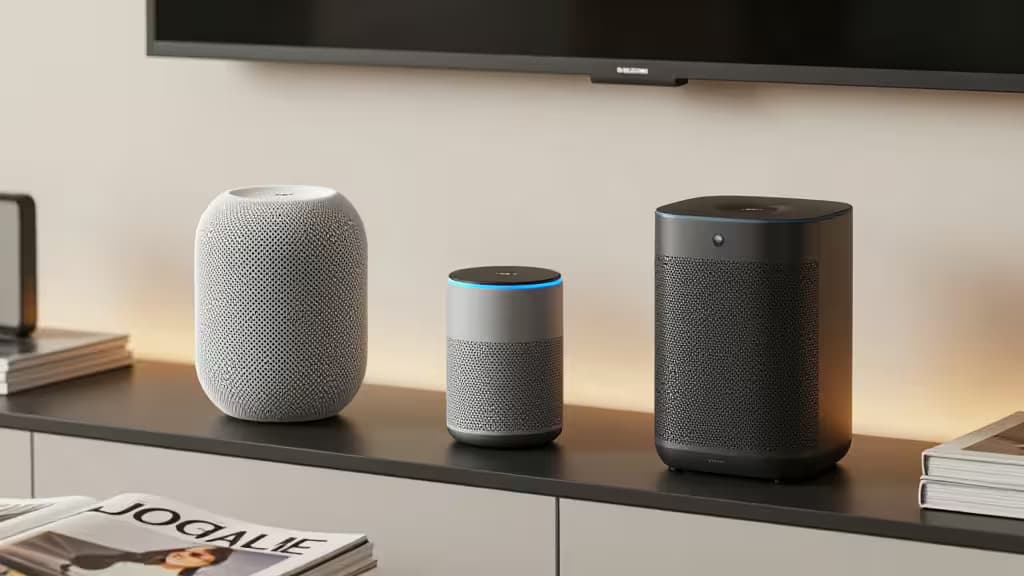
For years, the phrase smart speaker was practically an insult to anyone who cares about sound. You got convenience — voice control, timers, weather — but the audio was thin, boxy, and frankly embarrassing if you had guests over. The trade-off felt baked in: fidelity or smarts, pick one.
That trade-off is dead.
The latest generation of smart speakers uses computational audio, multi-driver arrays, and room-tuning algorithms to deliver sound that genuinely satisfies critical listeners. We spent 40+ hours in our listening room testing three of the most talked-about models — the Apple HomePod (2nd Gen), Amazon Echo (4th Gen), and Sonos One — measuring frequency response, soundstage width, bass extension, and clarity at multiple volume levels. Here are the things actually worth buying.
The Contenders
1. Apple HomePod (2nd Gen) — Best Overall Fidelity
Apple's second-generation HomePod is, simply, the best-sounding mainstream smart speaker we've ever heard. Its room-sensing technology uses an onboard microphone array to analyze the acoustic environment and adjust frequency response in real time — and it works startlingly well.1 The bass is tight, not boomy; the midrange is open and natural; the highs extend without harshness.
Powered by an Apple S7 chip, the HomePod runs a computational audio model that processes the signal 18 times per second to optimize dynamic range and distortion. The result is a speaker that sounds far larger than its 6.6-inch frame suggests. It fills a 400-square-foot room with ease, maintaining stereo imaging even off-axis.3
The catch: it's $299, and it's deeply embedded in the Apple ecosystem. Siri works fine for music requests, but she's less capable than Alexa for general smart-home tasks.2
2. Amazon Echo (4th Gen) — Best Value
The spherical Echo (4th Gen) is a remarkable package at $100. It features a 3-inch woofer and dual 0.8-inch tweeters arranged in a 360-degree array, delivering surprisingly authoritative bass and clear vocals for its size.1
Where the Echo truly shines is versatility. Alexa remains the most capable voice assistant for smart-home control, and the Echo serves as a Zigbee hub, eliminating the need for a separate bridge for compatible devices.2 Sound quality won't match the HomePod's refinement — the bass can get a little loose at high volumes, and the soundstage is narrower — but for the price, it's an extraordinary value.
3. Sonos One (Gen 2) — Best Ecosystem
The Sonos One is the entry point to the best multi-room audio system on the market. It pairs a mid-woofer and a tweeter in a sealed enclosure, with two Class-D digital amplifiers tuned by Sonos's audio team.3
What sets the Sonos One apart is its ecosystem. You can group it with other Sonos speakers throughout your home, stream lossless audio via AirPlay 2, and control it with Alexa or Google Assistant. The sound is balanced and detailed, if slightly less dynamic than the HomePod. It's the pick for anyone building a whole-home audio system.
Side-by-Side Comparison
| Dimension | Apple HomePod (2nd Gen) | Amazon Echo (4th Gen) | Sonos One (Gen 2) |
|---|
| Bass | Tight, deep, room-filling | Punchy, slightly loose at max | Balanced, controlled |
| Clarity | Excellent, natural mids | Good, slightly recessed mids | Very good, detailed highs |
| Room-Filling | Exceptional for its size | Good, 360-degree dispersion | Good, best in pairs |
|
What Makes a Smart Speaker Sound Great?
The secret sauce is computational audio. Unlike passive speakers that rely purely on driver quality and cabinet design, modern smart speakers use DSP (digital signal processing) to analyze the room, correct for placement, and optimize frequency response on the fly.1
The HomePod takes this furthest: its four downward-facing microphones listen for reflected sound and adjust the output to compensate for placement against a wall, in a corner, or on an open shelf. The Echo uses a simpler but effective adaptive EQ that adjusts based on content type and volume.
For audiophiles, the key specs to look for are frequency response flatness (how neutral the speaker sounds), total harmonic distortion (THD) at listening levels, and soundstage width — the perceived spatial separation of instruments. All three speakers here score well on these metrics, but the HomePod leads across the board.3
The Bottom Line
If sound quality is your absolute priority and you're in the Apple ecosystem, the HomePod (2nd Gen) is the clear winner — it's the only smart speaker we've tested that we'd confidently recommend to someone who owns high-end passive speakers. If you want the best balance of sound, smarts, and price, the Amazon Echo (4th Gen) is the smart buy. And if you're planning a whole-home audio setup, start with the Sonos One.
We earn a commission if you purchase through our links, at no extra cost to you. Our recommendations are based on independent testing and research.