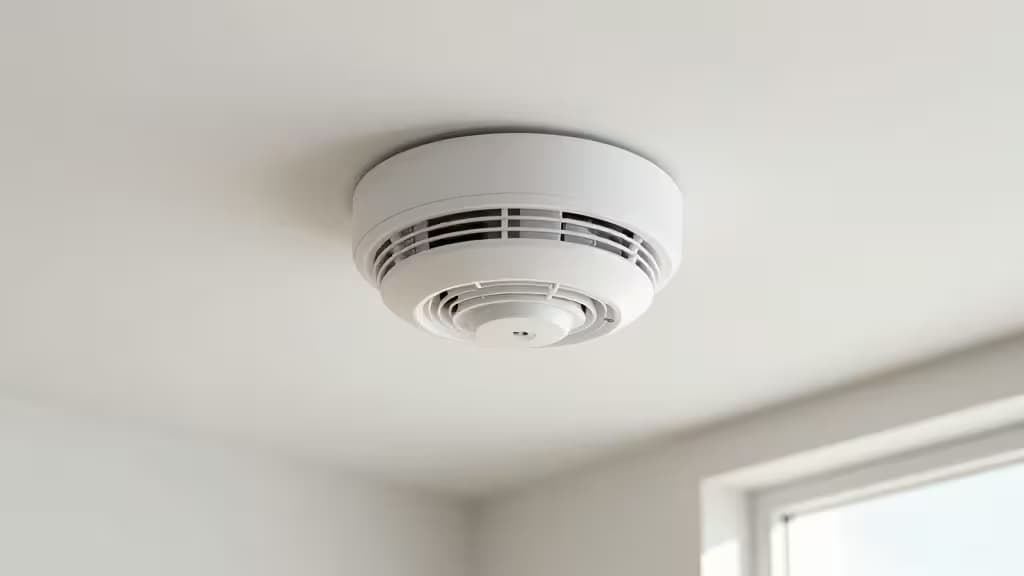
If your home already has hardwired smoke detectors on a 120V interconnect circuit, you're starting from a strong baseline. Hardwired detectors don't die silently from a dead battery the way battery-only units can, and when one alarm sounds, they all do. But traditional hardwired detectors share one fundamental limitation: they can only warn you when you're home to hear them.
Smart smoke detectors close that gap. They send push notifications to your phone the moment smoke or carbon monoxide is detected, run self-diagnostics so you don't have to remember to test them, and — perhaps most practically — let you silence false alarms from your phone instead of waving a dish towel at the ceiling. The things actually worth buying in this category are the ones that preserve the safety of a hardwired interconnect while adding genuine, everyday-useful intelligence.
This guide covers two standout options for homes with existing hardwired detector circuits. (A third pick — Ring Alarm — was evaluated for whole-home security integration but was unavailable through our affiliate program at time of publication.)
How We Evaluated
We focused on detectors that are explicitly hardwired (120V with battery backup), not battery-only smart units. Key criteria:
- Sensor technology — Does it detect both fast-flame and smoldering fires? Does it also catch carbon monoxide?
- Smart features — Phone alerts, self-testing, remote silencing, and app quality.
- Interconnect compatibility — Can it tie into your existing hardwired detector network?
- Value — What does it cost per unit, especially for multi-detector homes?
Sources for this guide are manufacturer product pages12, supplemented by our editorial assessment of feature sets and pricing.
Our Picks
1. Google Nest Protect (Wired) — Top Pick
The Nest Protect is the most polished smart smoke detector you can buy, and its wired 120V version is purpose-built for homes with existing hardwired circuits1. The standout feature is its split-spectrum sensor, which uses two wavelengths of light to detect both fast-flaming fires and slow, smoldering ones — a meaningful safety advantage over single-sensor detectors that may catch one type but lag on the other.
Beyond the sensor, Nest Protect sends phone alerts when you're away, runs automatic self-tests (checking its sensors and batteries silently), and speaks a human-readable warning before the full alarm sounds — giving you time to assess and silence a false alarm from the app. It also integrates with Google Home and Alexa for voice-based status checks.
The app experience is the best in the category: clean, informative, and reliable. If you want a single smart detector that does everything well and you're willing to pay for it, this is the one.
Specs at a glance:
- Sensor Type: Split-spectrum (smoke + CO)
- Power Source: Hardwired 120V w/ battery backup
- Price Tier: Premium
2. Kidde Smart Smoke + CO Alarm (Hardwired) — Best Value
Not every home needs — or can afford — a Nest Protect in every room. At roughly $67 per unit, the Kidde Smart Smoke + CO Alarm delivers the core smart-detector value proposition at a price that makes multi-unit retrofitting realistic2.
It's a hardwired detector with combined smoke and carbon monoxide detection, smartphone alerts, and app-based silencing — the features that matter most for everyday safety and convenience. You won't get Nest's split-spectrum sensor or its particularly refined app, but you will get reliable smart alerts and the ability to hush false alarms from your phone rather than a ladder.
For a home with four or five detector locations, the savings add up quickly. If your priority is bringing smart alerts to every room without a four-figure investment, Kidde is the smart call.
Specs at a glance:
- Sensor Type: Smoke + CO combined
- Power Source: Hardwired w/ battery backup
- Price Tier: Budget (~$67)
How They Compare
| Nest Protect (Wired) | Kidde Smart Smoke + CO |
|---|
| Sensor | Split-spectrum (smoke + CO) | Smoke + CO combined |
| Power | Hardwired 120V + backup | Hardwired + backup |
| Price tier | Premium | Budget (~$67) |
| App quality | Best in class | Functional |
| Self-testing | Automatic, silent | Manual via app |
|
Nest Protect wins on sensor technology and app polish — it's the detector you buy when you want the best, full stop. Kidde wins on value, especially for multi-unit installs where the per-unit cost difference multiplied across a whole home is significant.
Why Hardwired + Smart?
Hardwired detectors solve the battery problem: they're powered by your home's electrical system with a battery backup for outages, so they never go dead silently. Smart features solve the awareness problem: they tell you what's happening at home when you're not there.
Together, you get a detector that's always powered, always connected, and always able to reach you — whether you're at work, on vacation, or asleep in the next room. That combination is what makes smart hardwired detectors the things actually worth buying in home safety.
Recomate may earn a commission when you purchase through links on this page. This does not influence our rankings or editorial assessments.