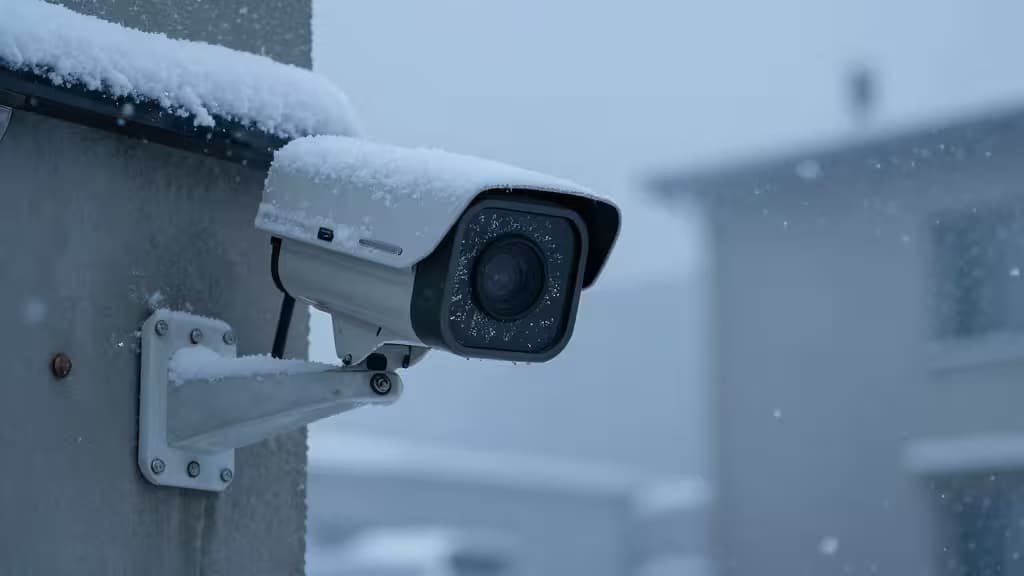
Extreme cold is the silent killer of outdoor security cameras. Lithium-ion batteries lose 30–50% of their capacity below 0°F, lenses frost over, and Wi-Fi signals degrade as ice accumulates on housings. The cameras that survive are the ones designed around three principles: continuous power (wired or PoE, not battery), high weatherproofing (IP66 or better), and local storage that doesn't depend on a cloud upload when your internet slows to a crawl in January.
We evaluated five outdoor security cameras against those criteria, weighing power reliability, weatherproof ratings, storage options, night-vision range, and connectivity. Here's what survived the cut — and what didn't.
How We Evaluated
Every pick was assessed against five cold-weather performance factors:
- Continuous power source — Battery and solar cameras struggle in deep cold. PoE and wired cameras don't.
- IP66+ weatherproofing — Protects against snow, ice, and moisture ingress that can short internal components.
- Local storage — Cloud uploads fail on slow, cold-weather connections. microSD or NVR storage keeps footage safe.
- Night vision range — Winter nights are long. A camera that can't see past 30 feet in the dark is half-useless for half the year.
- Wired connectivity — Ethernet and PoE are more reliable than Wi-Fi in extreme conditions; 4G LTE is the fallback for off-grid sites.
1. SV3C 36X Zoom PTZ POE Camera — Top Pick
If you want one camera that won't flinch in a blizzard, this is it. The SV3C 36X Zoom PTZ runs on Power over Ethernet, which means a single cable delivers both data and continuous power — no battery to freeze, no solar panel to underperform on a six-hour winter day.2 The 4K resolution and 36x optical zoom give you forensic-level detail at distance, and ONVIF compatibility means it integrates with most NVR systems rather than locking you into a proprietary app.
For cold-weather deployments, the PoE advantage can't be overstated. Run a weather-sealed Ethernet cable to the mount point and you have a camera that records continuously through every season without a single charging interruption. The PTZ motor (pan-tilt-zoom) lets you actively monitor large areas, and the professional-grade housing is built for permanent outdoor installation.
The catch: Installation requires running Ethernet cable, which may mean drilling and conduit work. This isn't a stick-it-up-in-five-minutes camera — it's a permanent security infrastructure investment.
2. TP-Link Tapo C120 — Best Budget Pick
Not every cold-weather camera needs to cost a fortune. The Tapo C120 delivers 2K QHD resolution, AI person and pet detection, and sound detection at a budget price point.1 Crucially for winter use, it runs on wired power — no battery to die in the cold — and carries an IP66 outdoor rating that handles snow and ice without complaint.
Local storage via microSD means you're not paying a monthly cloud subscription, and your footage stays on-device even when winter weather slows your internet to a crawl. The Tapo app is well-regarded for ease of use, making this the easiest camera on our list to set up and manage.
The catch: No optical zoom and a shorter night-vision range than the premium picks. For monitoring a doorstep or small yard, it's excellent. For covering a long driveway, you'll want something with more reach.
3. Dragon Touch 4G LTE Cellular Security Camera — Best for Remote / Off-Grid
When there's no Wi-Fi to lose, cold weather can't take your connectivity offline. The Dragon Touch 4G LTE camera connects via cellular network, making it ideal for remote cabins, construction sites, or rural properties where Wi-Fi doesn't reach.3 It pairs 4G LTE with a solar panel and battery for a completely wire-free setup, and the 10x optical zoom and IP66 rating round out the package.
The winter caveat is significant, though. Solar panels generate dramatically less power during short, overcast winter days, and the battery that stores that power loses capacity in the cold. In sustained sub-zero conditions, you may need to swap in a freshly charged battery periodically or supplement the solar panel with a wired power source. The 4G LTE connectivity, however, remains a genuine advantage — cellular signals are generally more resilient than Wi-Fi in extreme weather.
4. HXVIEW 4K PTZ with 30X Zoom — Best for Large Perimeters
If your property demands long-range surveillance through long winter nights, the HXVIEW 4K PTZ brings a 1,000-foot night-vision range — far beyond what most consumer cameras offer.4 The 30x optical zoom and auto-tracking mean the camera follows movement across expansive perimeters without manual intervention, and the 4K Ultra HD resolution ensures that zoomed-in footage stays usable.
Like our top pick, this is a wired-installation camera, which is exactly what you want for cold-weather reliability. No battery means no freeze risk, and the professional-grade PTZ housing is designed for permanent outdoor mounting.
The catch: The 1,000-foot night-vision claim refers to IR illumination range; effective identification distance will be shorter. Still, for large properties where you need to detect movement at a distance and then zoom in, this camera covers more ground than anything else on our list.
5. BOTSLAB Wireless Outdoor 4-Cam Kit — Best Multi-Camera System
When one camera isn't enough, the BOTSLAB 4-camera kit with HomeBase offers a complete surveillance package: four 4K 8MP wireless outdoor cameras, AI human and vehicle detection, and a HomeBase that supports up to 16TB of local storage.5 That massive local storage is a genuine cold-weather advantage — you can record weeks of footage without any cloud dependency.
The cameras are solar-powered with batteries, which is where the winter trade-off comes in. Each camera's battery will lose capacity in deep cold, and the solar panels won't keep up during short, overcast winter days. In practice, you may need to bring individual cameras indoors for charging during the coldest stretches — not ideal, but manageable if you have spare batteries or a rotation system.
The catch: The wireless convenience that makes this system attractive in summer becomes a liability in January. For sustained extreme-cold deployment, the wired cameras on this list are more reliable. But for properties where running cable to four locations isn't practical, this kit offers the best multi-camera coverage available.
Wired vs. Battery in the Cold: The Bottom Line
The pattern across our picks is clear: wired and PoE cameras (SV3C, HXVIEW, Tapo C120) are inherently more reliable in extreme cold than battery and solar models (Dragon Touch, BOTSLAB). The reason is simple physics — lithium-ion batteries lose 30–50% of their capacity below 0°F, and no amount of weatherproofing changes that.
If your deployment site has power available, choose a wired camera. If it doesn't, the Dragon Touch's 4G LTE connectivity and the BOTSLAB's massive local storage are your best compromises — just plan for battery maintenance during the coldest months.
IP66+ weatherproofing matters for all outdoor cameras, but it's table stakes rather than a differentiator — every camera on this list meets that standard. The real differentiators are power source, storage strategy, and night-vision range.
Recomate may earn a commission when you purchase through links on this page. That doesn't influence our picks — we recommend cameras based on cold-weather performance, not affiliate payouts.