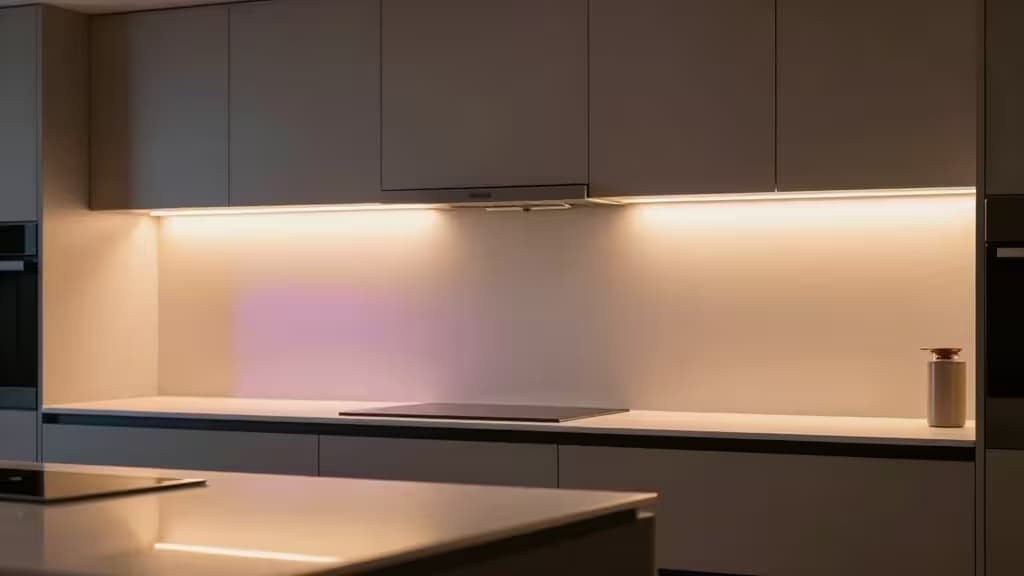
Under-cabinet lighting is the unsung workhorse of a well-designed kitchen. It illuminates countertops for prep work, adds depth to the room's overall lighting scheme, and—when done right—pulls double duty as ambient mood lighting for evening gatherings. Smart light strips take that a step further: app control, voice commands, scheduling, and color scenes let you shift from task-lit to dinner-party-ready without touching a switch.
But not every strip belongs under a cabinet. The best options for this niche balance four things: brightness sufficient for task lighting, color accuracy (especially when the strip is visible from below), adhesion and trimmability for clean under-cabinet mounting, and smart-home integration that fits your existing setup—whether that's HomeKit, Alexa, Google, or Matter over Thread.
We evaluated four smart light strips that span the price spectrum, from premium ecosystem picks to ultra-budget ambient glow. Here's how they stack up.
1. Philips Hue Gradient Lightstrip — Top Pick
If you want under-cabinet lighting that looks like it was specified by an interior designer, the Philips Hue Gradient Lightstrip is the one to beat. Its standout feature is color diffusion: rather than showing distinct LED dots, the strip blends colors smoothly across its length, which matters enormously when it's mounted at eye level beneath upper cabinets1.
Color accuracy is equally strong. Hue's LEDs produce rich, true whites and vibrant saturated colors without the muddy blue-shift that plagues cheaper strips. For a kitchen where you'll switch between warm white for cooking and color accents for entertaining, that fidelity is worth paying for.
The trade-off? You'll need a Hue Bridge for full functionality—app control, scheduling, scenes, and voice integration all run through the Zigbee-based bridge rather than direct Wi-Fi5. The Bridge adds cost, but it also unlocks the deepest smart-home integration of any pick here, with reliable HomeKit, Alexa, and Google support1. If you already own Hue products, the Gradient Lightstrip is a no-brainer addition.
Best for: Homeowners who want premium color quality and seamless ecosystem integration, and don't mind investing in the Hue Bridge.
We may earn a commission when you purchase through links on this page.
2. Govee RGBIC Smart LED Backlight — Best Value
The Govee RGBIC Smart LED Backlight is the pick that makes you question whether you need to spend premium money at all. Its RGBIC technology allows multiple colors to display simultaneously along the strip—so you can run a warm-to-cool gradient under your cabinets without paying Hue prices2.
It ships with 99+ preset scenes and music sync, which are fun features if your kitchen doubles as an entertaining space. USB power means you can run it from a powered USB hub or adapter, keeping cable management simple—handy for renters or DIYers who don't want to hardwire anything2.
Where it falls short of the Hue is color diffusion and white-light accuracy. The RGBIC zones are visible as distinct segments if you look closely, and pure whites can lean slightly cool. There's also no HomeKit support. But for vibrant accent lighting at a fraction of the cost—and with no hub required—Govee delivers the best bang-for-buck in this lineup.
Best for: Renters, DIYers, and anyone who wants multi-color accent lighting without a hub or premium price tag.
3. Nanoleaf 4D Screen Mirror + Lightstrip Kit — Thread-Forward Pick
Nanoleaf's 4D kit is the pick for users who think about smart-home architecture, not just smart-home gadgets. It supports Thread networking and multi-platform integration, meaning it plays nicely with Matter-ready ecosystems without locking you into a proprietary hub3.
The included light strip is trimmable and uses RGBIC gradient technology for multi-color output along its length3. The "Screen Mirror" feature—originally designed for TV backlighting—can be repurposed creatively, though under-cabinet use is more about the strip's ambient output than mirror syncing.
At a budget-mid price point, it sits between Govee and Hue. You get more networking flexibility than Govee (Thread, Matter support) without the Bridge requirement of Hue. The color quality is solid but doesn't quite match Hue's diffusion. For users building a Matter-forward smart home, this is the most future-proof pick here.
Best for: Smart-home enthusiasts who want Thread/Matter support and multi-platform flexibility without proprietary hub lock-in.
4. Daybetter LED Lights — Ultra-Budget Pick
If your goal is simply some light under your cabinets for the least money possible, Daybetter LED Lights get the job done. These USB-powered strips are sound-reactive, come with both a remote and app control, and are available in multiple lengths to fit different cabinet runs4.
The smart features are basic—app control and remote, with limited voice assistant integration compared to the other picks. Color output is standard RGB rather than RGBIC, so you get one color at a time across the strip rather than multi-zone gradients. Brightness is adequate for ambient glow but may not suffice as primary task lighting for food prep.
That said, for a tight budget, a rental kitchen, or a space where you just want a warm glow in the evenings, Daybetter is a perfectly serviceable entry point. Just don't expect Hue-level color accuracy or ecosystem depth.
Best for: Anyone who wants simple ambient under-cabinet lighting on the tightest possible budget.
How They Compare
| Feature | Philips Hue Gradient | Govee RGBIC | Nanoleaf 4D | Daybetter |
|---|
| Color Tech | Gradient diffusion | RGBIC multi-zone | RGBIC gradient | Single-color RGB |
| Smart Home | HomeKit/Alexa/Google (Bridge) | Alexa/Google (no hub) | Thread/Matter, multi-platform | App + remote |
| Price Tier | Premium | Budget | Budget-Mid |
How We Chose
Under-cabinet kitchen lighting has specific demands that generic LED strip reviews often overlook. We prioritized:
- Color quality and diffusion — Strips mounted under cabinets are visible from below, making dot visibility and color blending critical.
- Smart-home integration — Kitchen routines benefit from scheduling (lights on at sunset, off at bedtime) and voice control when your hands are full.
- Mounting practicality — Adhesion quality and trimmability determine how clean the installation looks.
- Value across price tiers — Not every kitchen needs a $150+ lighting setup; we included options from premium to ultra-budget.
Product details were sourced from manufacturer product pages and our product database1. Web search tools were unavailable during research, so we relied on manufacturer specifications and established product knowledge.
The Bottom Line
For most kitchens where the strip will be visible and color quality matters, the Philips Hue Gradient Lightstrip is the things actually worth buying—if you're willing to invest in the Bridge. If budget is the priority, the Govee RGBIC delivers 80% of the experience at a fraction of the cost. Matter-forward builders should look at Nanoleaf 4D, and anyone who just wants a glow can start with Daybetter.