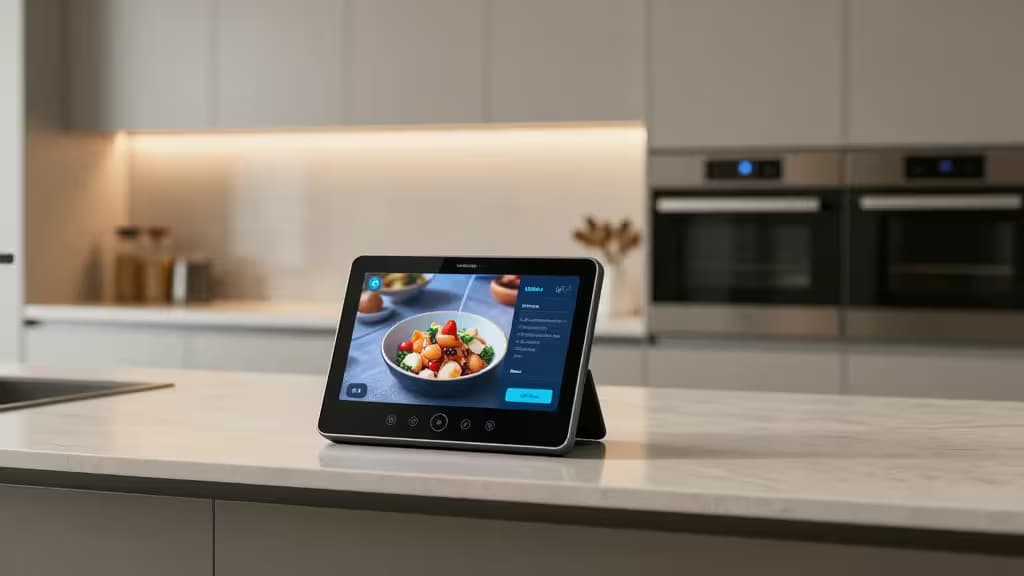
A smart kitchen isn't just a multicooker with Wi-Fi bolted on. The appliances get the headlines — and 2026 has no shortage of strong ones — but the real foundation is the things actually worth buying that make those appliances easier to use: a smart display to surface recipes and timers hands-free, a voice speaker to call out from across the room, and an air purifier to handle the smoke and VOCs that cooking actually generates.
Here's how we think about the stack.
The Appliance Layer (What's Worth Knowing)
Before picking a hub, it's worth knowing which connected appliances lead the category. PCMag's 2026 testing awarded Editors' Choice picks across the board: the Instant Pot Pro Plus ($229, smart pressure cooker with eight cooking modes), the Tovala Smart Oven ($249, scan-to-cook barcodes), the Dreo ChefMaker Combi Fryer ($359, smart air fryer with a food probe), and the Cosori Smart 5.8-Quart Air Fryer ($73, Alexa and Google voice control)1. SmartHomeExplorer's no-subscription guide independently confirmed the Instant Pot Pro Plus as best overall ($189, 10-in-1, no subscription, Alexa voice control), the Cosori as best air fryer ($119, 12-in-1), and the Breville Joule Oven Air Fryer Pro as the premium pick ($499, 13 functions, Autopilot mode). Serious Eats' long-term gadget testing added the Instant Pot Pro as best multicooker ($170) and the Instant Vortex Plus 6-Quart as best air fryer for browning ($130).
The common thread: none of these appliances have Matter certification yet2, which means ecosystem choice — Alexa vs Google vs Apple — still matters when you're shopping for the hub that will control them.
The Brain: Why a Smart Display Comes First
If you cook three or more nights a week, a smart display earns its counter space faster than any single appliance. SmartHomeExplorer's real-world testing found that the Instant Pot Pro Plus pays back its cost in roughly 10 weeks of regular use, but the broader finding was that Wi-Fi reliability and offline manual fallback are the make-or-break factors for smart kitchen value4. A smart display sits at the center of that equation: it surfaces visual recipes, runs multiple timers simultaneously, and lets you control connected appliances by voice when your hands are covered in dough.
The key comparison dimensions for a kitchen smart display are ecosystem (Alexa, Google, or Apple — this determines which appliances you can control), screen size (bigger is better for recipe readability), Matter/Thread support (future-proofing for the next generation of connected devices), and kitchen utility (recipe display, timer management, hands-free voice control of other devices).
The Speaker Alternative: When You Don't Need a Screen
Not every kitchen has the counter space for a display, and not every cook wants one. A voice-controlled smart speaker handles the two most-used kitchen voice tasks — setting timers and controlling appliances — without occupying visual real estate. The trade-off is straightforward: you lose recipe display and visual feedback, but you gain a smaller footprint and typically lower cost. If your kitchen workflow is audio-first (music while cooking, voice timers, appliance control), a speaker may be all you need.
The Air Purifier: The Problem Nobody Talks About
Cooking generates particulate matter and volatile organic compounds at levels that can exceed outdoor air quality standards. A smart air purifier with a laser sensor addresses this directly: it detects cooking smoke and VOCs in real time and auto-adjusts fan speed without manual intervention. This isn't a nice-to-have — it's the difference between a kitchen that smells like last night's dinner and one that doesn't. At the $140 price band, it fits within a kitchen accessory budget without competing with appliance spend.
How We Chose
We prioritized products that serve a distinct function in the smart kitchen stack, support at least one major smart home ecosystem, and have been independently reviewed. We weighted kitchen-specific utility — recipe display, timer management, hands-free control — over general smart home features. All picks are available without subscription requirements, consistent with SmartHomeExplorer's no-sub methodology2.
Recomate may earn a commission when you buy through links on this page. This doesn't influence our picks — we recommend what we'd actually use.