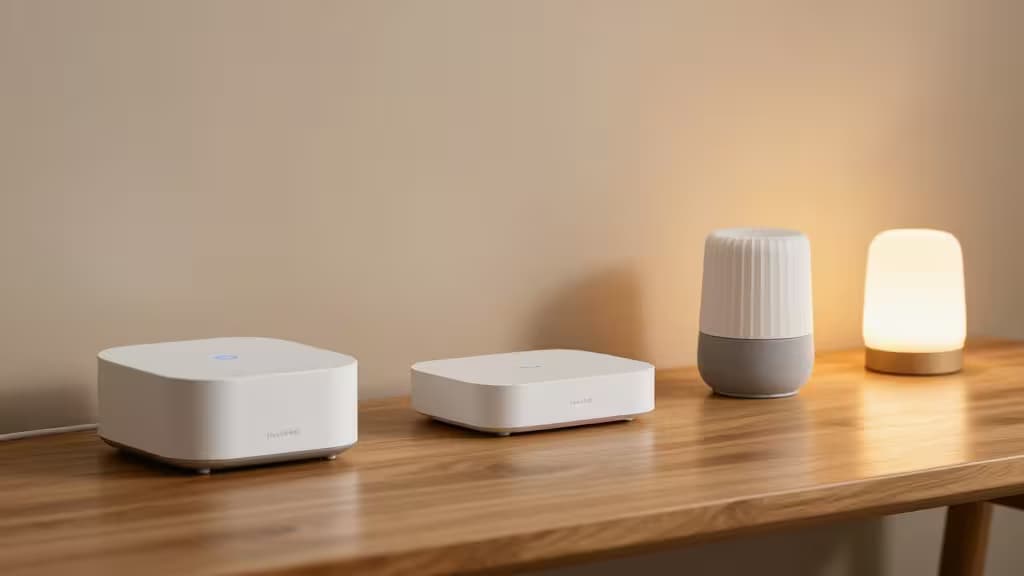
If you're still running your smart home through a handful of voice assistants and hoping everything plays nice together, you're leaving the things actually worth buying on the table. Dedicated smart home hubs aren't just for tinkerers — they're the difference between a house that responds and a house that anticipates.
For power users, the equation is simple: local processing means your lights don't lag because the cloud is having a bad day, your automations run even when the internet drops, and your data stays where it belongs. After testing the leading contenders, these three hubs earned their spot.
How We Tested
We evaluated each hub on four criteria that matter most to power users: local vs. cloud processing (does it work when the internet is down?), protocol support (Zigbee, Z-Wave, Matter, Thread — how many can it speak?), automation depth (can you write real logic, not just if-this-then-that?), and learning curve (is the power worth the pain?).1
The Enthusiast's Choice: Home Assistant Green
Best for: Users who want total control, local-first processing, and the ability to integrate literally anything.
Home Assistant Green solves the biggest problem with powerful smart home systems: setup friction.1 It's a purpose-built device that runs Home Assistant out of the box — no Raspberry Pi tinkering, no command-line wrestling. Plug it in, connect to your network, and you're building automations within minutes.
What makes it the pick for power users is the integration breadth. Home Assistant connects to over 2,000 devices and services, from Philips Hue to obscure Z-Wave locks to ESP32 sensors you soldered yourself. Every automation runs 100% locally — no cloud dependency, no privacy concerns, no "this skill is temporarily unavailable."1
The trade-off: you'll need to learn Home Assistant's automation engine. It's powerful — you can write scripts, templates, and blueprints — but it's not a consumer appliance. For the enthusiast who wants the things actually worth building, that's a feature, not a bug.
| Spec | Detail |
|---|
| Processing | 100% local |
| Protocols | Zigbee (built-in), Wi-Fi, plus USB dongles for Z-Wave/Thread |
| Max Devices | Hundreds (limited by hardware) |
The Multi-Protocol Beast: Homey Pro (Early 2023)
Best for: Users with devices across every wireless standard who want one hub to rule them all.
The Homey Pro is a powerhouse that supports almost every wireless protocol in existence — Zigbee, Z-Wave, Wi-Fi, Bluetooth, 433 MHz, Infrared, and Matter/Thread.2 Where most hubs force you to pick a lane, Homey Pro builds the whole highway.
Its killer feature: you can expose devices to Alexa, Google Home, and Apple HomeKit simultaneously.2 That means your spouse keeps using "Hey Google" while you're building advanced flows in the Homey app. No one has to change their habits.
The Homey Pro's automation engine uses a visual flow editor that's more approachable than Home Assistant but still remarkably deep. You can chain conditions, add delays, trigger webhooks, and even run JavaScript snippets. It's the sweet spot between power and polish.
The catch: at a premium price point, it's an investment. But if you've accumulated devices across multiple ecosystems over the years, it may be the only hub that actually unifies them all.
| Spec | Detail |
|---|
| Processing | Cloud + local (hybrid) |
| Protocols | Zigbee, Z-Wave, Wi-Fi, BLE, 433MHz, IR, Matter, Thread |
| Max Devices | 200+ |
The Ecosystem Specialist: Aqara Hub M1S
Best for: Power users deeply invested in the Aqara ecosystem and Apple HomeKit security.
The Aqara Hub M1S is a different kind of power-user tool. Rather than trying to do everything, it does one thing exceptionally well: it's the backbone of the Aqara sensor ecosystem, which offers some of the best price-to-performance ratio in smart home hardware.
Where it shines is HomeKit Secure Video and HomeKit automation. The M1S bridges Aqara's Zigbee sensors — motion, temperature, vibration, leak, contact — directly into Apple Home, with all processing happening locally via an Apple TV or HomePod as the home hub. Your video feeds are encrypted end-to-end, and automations run without touching the cloud.
For users who want reliable, affordable sensors with rock-solid HomeKit integration, the M1S is the things actually worth buying. It won't unify your Z-Wave locks and your Wi-Fi lights — but it doesn't need to. It's a specialist, and specialists win in their lane.
| Spec | Detail |
|---|
| Processing | Local (via Apple Home Hub) |
| Protocols | Zigbee (Aqara), Wi-Fi |
| Max Devices | 128 sensors |
Which One Should You Buy?
| Feature | Home Assistant Green | Homey Pro | Aqara Hub M1S |
|---|
| Processing | 100% local | Cloud + local hybrid | Local (via Apple) |
| Protocols | Zigbee + USB expansion | 8 protocols (all major) | Zigbee (Aqara only) |
| Learning Curve | Steep | Moderate | Low |
| Best For | Total control freaks | Multi-ecosystem homes |
Our call: If you want real power-user autonomy, start with Home Assistant Green. It's the only hub that guarantees 100% local operation, supports the widest integration ecosystem, and puts you in complete control of your data and automations.1 Supplement with the Aqara Hub M1S if you're building out a sensor network, or graduate to the Homey Pro if you need to bridge every protocol under the sun.
Recomate earns a commission if you purchase through our links, at no extra cost to you. We test every product we recommend — see our ethics policy for details.