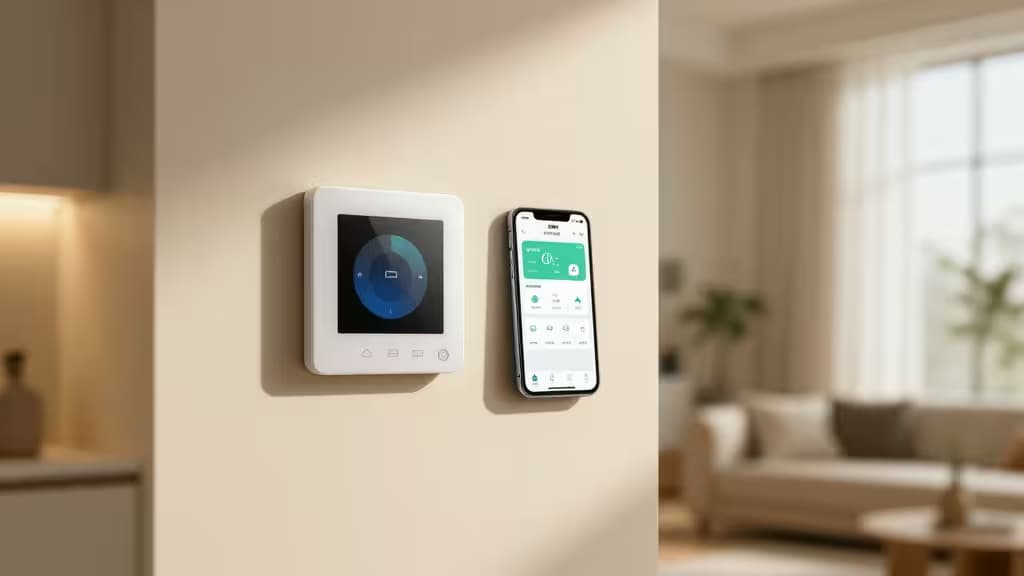
The three levers that actually move your bill
Up to 20% of the typical $2,000 annual US home-energy bill goes to waste — lights left on, HVAC running in empty rooms, sprinklers watering in the rain, devices drawing phantom power at 3 a.m.1 The smart home's real promise isn't novelty; it's automation that quietly closes those gaps. Three levers do most of the work:
- Cut HVAC runtime. ENERGY STAR-certified smart thermostats save roughly 8% of heating and cooling bills — about $50 per year on average, and potentially more depending on climate and occupancy.2
- Kill vampire draw. Smart plugs and hubs let you schedule or voice-trigger shutoff of idle electronics, eliminating the standby power that adds up across a house full of devices.1
- Reduce outdoor water — and the pump electricity behind it. Smart sprinklers with weather-based scheduling can cut irrigation water by 30–40% (manufacturers' claims; CNET's testing shows less but still real savings), and every gallon saved is a gallon your well pump or municipal system doesn't have to move.3
The devices below tackle each lever. We picked them for measurable electricity savings, not gimmicks.
Our picks
1. Rachio 3 — Best smart sprinkler overall
CNET's best overall smart sprinkler, the Rachio 3 is WaterSense-certified and uses hyperlocal weather data to skip watering before rain and adjust schedules by season.3 That automation cuts water use and, by extension, the electricity your irrigation pump draws. The app is well-designed, and integration with Alexa and Google Assistant means you can pause watering by voice when you're heading outside.
If you have a larger lawn or just want the most polished scheduling logic, this is the one to get.
2. Orbit B-hyve — Best value smart sprinkler
The Orbit B-hyve XR delivers the same WaterSense-certified weather adjustments as the Rachio at roughly half the price — CNET lists it at $108 versus $199 for the Rachio.3 It's rated IPX-5 waterproof for outdoor installation, which matters if your valve box isn't sheltered. You give up some of the Rachio's polish in the app and third-party integrations, but the core savings mechanism — weather-based skip and seasonal adjustment — is the same.
For a budget-conscious setup or a second irrigation zone, it's the smart call.
3. Emporia Classic EV Charger — Best for off-peak charging
If you drive electric, when you charge matters as much as how far you drive. The Emporia Classic is an affordable Level 2 charger with app-based scheduling that lets you push charging to off-peak hours when rates drop.5 Pair it with the Emporia Vue energy monitor and you get whole-home draw tracking in the same app — so you can see exactly how much electricity the car pulls alongside everything else.5
That visibility is the point. You can't optimize what you can't measure, and Emporia's ecosystem puts the meter and the charger on one screen.
4. Amazon Echo (4th Gen) — Best hub for energy automations
Smart plugs and schedules only save money if you actually use them. The Amazon Echo (4th Gen) is the orchestration layer that makes energy routines stick — a single voice command can trigger a routine that shuts off every light and smart plug in the house, eliminating vampire draw without you remembering to flip switches.16 PCMag's testing covers hubs alongside thermostats and energy-monitoring plugs as core smart-home energy tools.6
Think of it as the brain that makes the other picks work together — the sprinkler, the charger, and the purifier all benefit from centralized scheduling, and the Echo is the most accessible way to tie those routines into one system.
5. Levoit Vital 200S — Best energy-efficient air purifier
Air purifiers are silent energy hogs if left on high 24/7. Smart Air's analysis found that energy-efficient models can save $100+ per year on electricity, and that CADR-per-watt is the key efficiency metric — it tells you how much clean air you get for each watt drawn.4 The Levoit Vital 200S has a laser particle sensor that auto-adjusts fan speed to real-time air quality, ramping up only when needed and dropping to a low-wattage idle when the air is clean.4
That auto mode is what separates a smart purifier from a dumb fan. Smart Air notes that auto mode significantly reduces energy consumption versus running on high around the clock — and the savings show up on your bill.4
How we evaluated
We focused on devices with a clear, measurable path to electricity savings — not convenience for its own sake. Sources include Wirecutter's energy-saving smart-home guide1, ENERGY STAR's thermostat savings data2, CNET's smart sprinkler testing3, Smart Air's air-purifier energy analysis4, Emporia's product documentation5, and PCMag's smart-home device testing6.
Recomate may earn a commission when you purchase through links on this page. That doesn't influence our picks — we recommend the devices we believe deliver real savings.