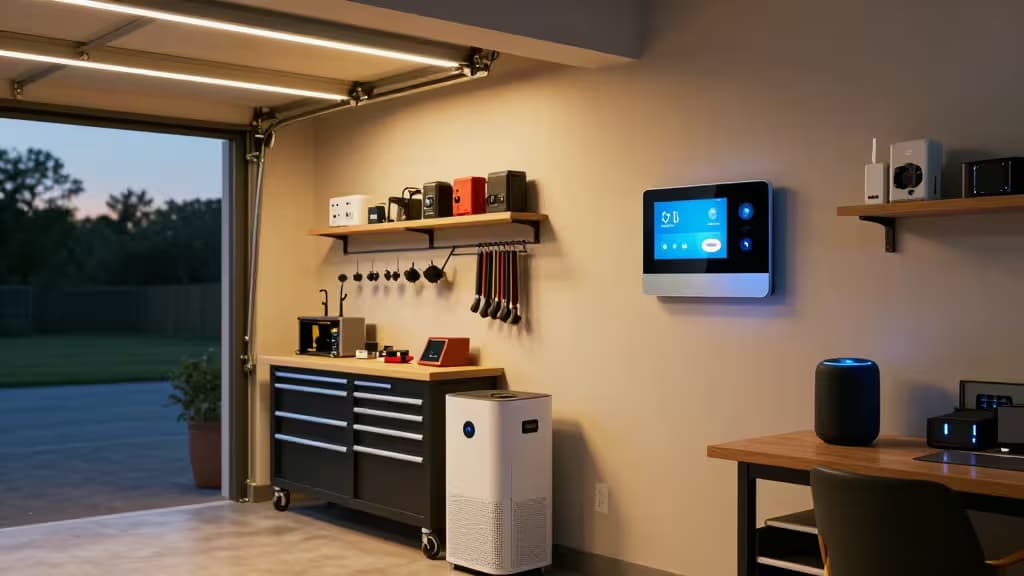
Garages and workshops are the most overlooked spaces for smart home upgrades — yet they're where you need automation most. Between vehicle access, airborne dust and VOCs, power-hungry tools, and security concerns, a handful of well-chosen smart devices transform a detached or attached garage into a safer, more efficient workspace.
We looked at the five pain points every garage and workshop shares: getting in and out, breathing clean air, knowing what your tools cost to run, keeping the space secure, and controlling everything when your hands are full. Here are the things actually worth buying.
1. Tailwind iQ3 — Best Smart Garage Door Controller
The Tailwind iQ3 is a retrofit controller that makes your existing garage door opener smart without replacing it. Its standout feature is Bluetooth-based vehicle detection: as your car pulls into the driveway, the door opens automatically — no button press, no app tap, no remote needed.1 That alone makes it a meaningful upgrade over the Chamberlain myQ Smart Garage Hub, which offers remote access and smart home integration but lacks automatic vehicle detection.2
The iQ3 supports multi-door control (handy if you have a two-car garage) and integrates with both Alexa and Google Home for voice commands. If you're starting from a built-in opener like the LiftMaster 84505R Secure View — a professional-grade unit with an integrated 1080p camera and two-way audio3 — you don't need a retrofit controller at all. But for everyone with an existing opener that just needs a brain transplant, the Tailwind iQ3 is the cleanest path.
Why it's our pick: Bluetooth auto-open is the feature that actually changes your daily routine. No fumbling for a remote, no app to open — the door just opens as you arrive.
2. AirDoctor 3500i — Best Air Purifier for Workshop Fumes and Dust
Workshops generate a toxic cocktail: sawdust, paint fumes, solvent vapors, and exhaust. The AirDoctor 3500i tackles all of it with a three-stage filtration system — a pre-filter for large particles, a HEPA filter for fine dust, and a VOC filter for chemical fumes — plus a high Clean Air Delivery Rate (CADR) that cycles air quickly in larger spaces.4 The smart app sends alerts when filters need replacing or air quality drops.
The budget alternative is the Levoit Vital 200S, which offers a laser air quality sensor, smartphone app, and carbon filter for VOCs at a lower price point.5 It's a solid pick for a small home garage. But for a workshop where you're cutting, sanding, or painting regularly, the AirDoctor's higher CADR and medical-grade filtration justify the premium.
Why it's our pick: When you're working with MDF, lacquer, or a running engine, you need filtration that moves serious air. The AirDoctor 3500i is built for that workload.
3. Emporia Classic — Best Energy Monitor
Garages and workshops are energy black holes: space heaters, compressors, welders, battery chargers, and EV chargers all draw significant power, and most homeowners have no idea what those devices actually cost to run. The Emporia Classic energy monitor installs in your electrical panel and provides whole-home and circuit-level electricity monitoring, so you can see exactly what your workshop circuits are pulling in real time.7
This is the device that turns vague guesses into data. Wire it to the circuits feeding your garage and you'll know whether that old space heater is costing you $40 a month or $4. It integrates with Alexa and Google Home for voice queries, and the app provides historical usage charts.
Why it's our pick: You can't manage what you don't measure. Circuit-level monitoring is the difference between knowing your workshop costs $30 a month to run and guessing.
4. Aqara Hub M1S — Best Budget Hub and Security Gateway
A garage full of tools is a prime target for theft, and a detached garage is especially vulnerable. The Aqara Hub M1S is a compact Zigbee hub that serves as the backbone for a complete garage security system: pair it with Aqara door/window sensors on the garage door and side entrance, motion sensors inside, and leak sensors under the water heater. It includes a built-in siren for alarms and supports Apple HomeKit alongside Alexa and Google.6
At its price point, it's hard to beat as a security gateway. The Zigbee protocol means sensors run on coin-cell batteries for months, and the hub itself plugs into a standard outlet. If you're already deep in the Aqara ecosystem elsewhere in your home, adding a second hub for the garage is a natural extension.
Why it's our pick: A built-in siren plus Zigbee sensor support gives you a real security system for the price of a single smart speaker.
5. Amazon Echo (4th Gen) — Best Voice Assistant for the Workshop
When your hands are covered in sawdust, holding a power tool, or carrying a sheet of plywood, voice control isn't a gimmick — it's essential. The Amazon Echo (4th Gen) gives you hands-free control of lights, the garage door (via Tailwind), music, timers, and any other connected device in the workshop.8 It also serves as a Matter and Thread hub, which means it can act as a central controller for next-generation smart home devices.
The Echo doubles as a workshop speaker for podcasts and music, and its built-in temperature sensor can trigger automations — say, turning on a fan when the garage gets too hot. Compared to the Aqara Hub M1S, the Echo trades Zigbee sensor support for superior voice capabilities and a built-in speaker. For most workshops, having both is ideal: the Aqara handles sensors and security, the Echo handles voice and music.
Why it's our pick: "Alexa, turn on the shop lights" while you're walking in with arms full is the moment you understand why voice control exists.
How They Work Together
The strength of this lineup is that every device addresses a distinct garage problem and they integrate through shared ecosystems:
- Access: Tailwind iQ3 handles the garage door, controllable by voice through the Echo.
- Air quality: AirDoctor 3500i runs independently but can be scheduled and monitored via its app.
- Energy: Emporia Classic gives you circuit-level data on everything in the garage.
- Security: Aqara Hub M1S manages door, motion, and leak sensors with a built-in siren.
- Voice control: Amazon Echo ties it together — open the door, turn on lights, set a timer, play music, all hands-free.
You don't need all five to see a difference. Start with the Tailwind iQ3 if vehicle access is your daily frustration, or the AirDoctor 3500i if air quality is your health concern. Add the rest as your needs — and your budget — grow.
Disclosure: Recomate may earn a commission when you purchase through links on this page. That doesn't influence our picks — we recommend what we believe is genuinely worth buying.