Why a Single Gadget Won't Save Your Pipes
The average frozen-pipe insurance claim runs about $27,0002, and most insurers will only reimburse a vacant-property catastrophe if you maintained approximately 55°F of heat in the home2. That's a staggering number for something a few well-placed sensors and automations can largely prevent.
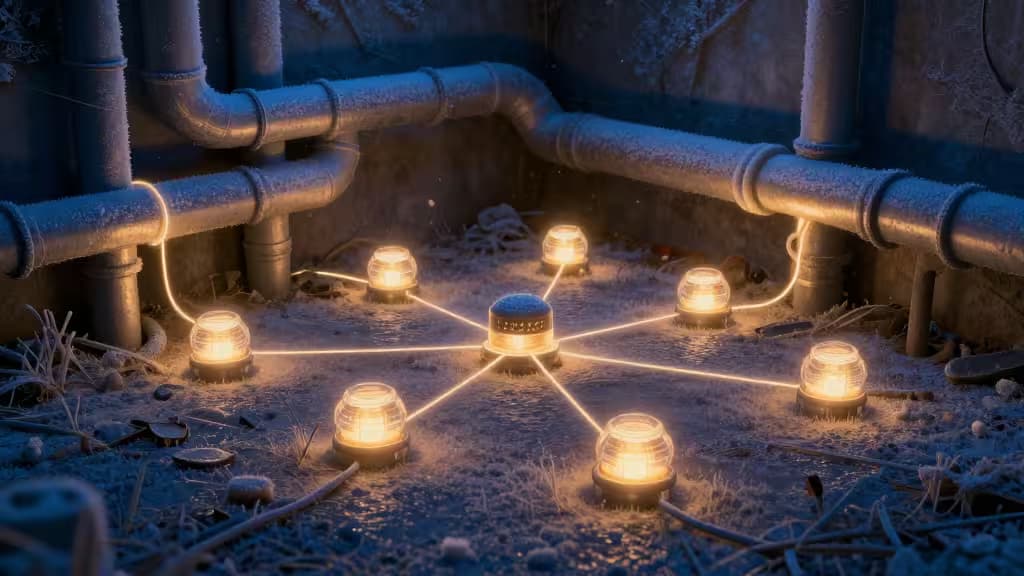
But here's the catch: no single device prevents frozen pipes. It's a layered system — defense in depth, not a silver bullet. Temperature sensors catch dropping temps before freezing starts1. Leak detectors warn you if pipes start weeping1. A hub ties those sensors to alerts and automations. A smart plug powers heat tape or heating cables on a schedule or when the temperature drops1. A thermostat maintains a minimum temperature even when you're away3. And a monitoring display keeps you informed at a glance, whether you're in the next room or across the country.
We've assembled five devices that, together, form that stack. Each one earns its place by doing something the others can't.
The Picks
1. Aqara Hub M1S — The Sensor Backbone
The Aqara Hub M1S is the foundation of a budget freeze-protection sensor network. It connects Zigbee devices to your Wi-Fi network and manages smart scenes across Apple HomeKit, Google Assistant, Amazon Alexa, and Mi Home4. That cross-platform support matters: you're not locked into one ecosystem, and alerts can reach you through whichever assistant you already use.
Pair the hub with Aqara's low-cost water leak sensors and temperature/humidity sensors to monitor crawl spaces, under-sink cabinets, and areas near exposed pipes. Because Zigbee sensors are inexpensive, you can afford to place several — and multi-point monitoring is exactly what freeze protection demands. One sensor in the basement won't tell you that the pipe under the kitchen sink is approaching 32°F.
Verdict: Best sensor ecosystem value. If you're building a multi-point monitoring network on a budget, start here.
2. Amazon Echo (4th Gen) — The Budget Temperature-Trigger Hub
The Echo (4th Gen) has a built-in temperature sensor, and compatible Echo devices can act as smart temperature sensors within Alexa6. More importantly, Alexa Routines let you create temperature-triggered automations5 — so when the Echo's sensor detects that a room has dropped below your threshold, it can send you an alert and trigger a connected smart plug to power on heat tape or a space heater.
This is the logic layer of your freeze-protection stack. The Echo doesn't just sit there listening; it's actively watching the temperature and executing automations when conditions cross a line you define.
Verdict: Best budget temp-trigger hub. Affordable, capable, and the brain behind your automated response.
3. Kasa Smart Outdoor Plug KP401 — The Heat Cable Automator
Many vulnerable pipes run outdoors or through unheated spaces where a standard indoor smart plug can't survive. The Kasa KP401 carries an IP64 weatherproof rating for outdoor use7 and is rated for 15A — enough to handle pipe heat tape and heating cables, which are among the heavier loads in a smart-home setup.
Wire this into an Alexa Routine triggered by the Echo's temperature sensor, and your heat tape activates automatically when the temperature drops — no manual intervention, no forgetting to flip a switch before a cold snap. You can also set a schedule so the cable runs during the coldest overnight hours and shuts off during the day.
Verdict: Best for automating heat cables. The weatherproof, high-amperage link between "temperature dropped" and "heat is on."
4. Google Nest Hub Max — The Nest Thermostat Dashboard
Google's Nest thermostats include a Safety Temperatures feature that turns on heating even when the thermostat is set to Off3. If your home reaches a set temperature limit, the thermostat activates to ensure pipes won't freeze, and it sends a notification to your phone3. Heating Safety Temperature is on by default3 — but you need a way to monitor and manage it remotely.
The Nest Hub Max serves as that dashboard. It's the interface for checking your thermostat's status, adjusting Safety Temperature thresholds, and receiving alerts while you're away. For anyone already in the Nest ecosystem, it's the natural command center for the "maintain minimum temperature" layer of your defense.
Verdict: Best for Nest thermostat integration. The monitoring and control surface for the auto-heat safety net.
5. Amazon Echo Show 8 (3rd Gen) — The Compact Monitoring Display
Not every freeze-vulnerable spot needs a full-size hub. The Echo Show 8 (3rd Gen) includes a built-in temperature sensor and a visual display, making it ideal for placement in a garage, utility room, or near other exposed areas where you want at-a-glance readings rather than a phone check.
The screen lets you see sensor readings and freeze alerts visually — useful when you're walking through the house doing a pre-storm check and want to glance at a display rather than pull out your phone for every room. Like the Echo (4th Gen), it supports Alexa Routines for temperature-triggered automations5, so it doubles as a local trigger point in addition to being a monitor.
Verdict: Best compact monitoring display. Put it where you need eyes on the temperature, not just ears.
How the Stack Works Together
Here's the flow when everything is connected:
- Sensors detect danger. Aqara temperature and leak sensors placed near pipes report dropping temperatures or moisture to the Hub M1S1.
- The hub triggers alerts. The Hub M1S pushes notifications through Alexa, Google, or HomeKit4, so you learn about the problem immediately.
- Automations respond. An Echo (4th Gen) or Echo Show 8 detects a temperature threshold crossing and fires an Alexa Routine5 that switches on the Kasa KP401, powering heat tape along vulnerable pipes1.
- The thermostat holds the line. A Nest thermostat's Safety Temperatures feature activates heating to keep the home above freezing, even if the thermostat is off.
No layer is redundant. Sensors without automations just tell you about a problem you can't fix remotely. Automations without sensors have nothing to trigger on. A thermostat without monitoring leaves you blind when you're away. The strength is in the combination.
A Note on Insurance and Vacant Homes
If you own a vacation home or leave your primary residence unoccupied during winter, the stakes are higher. Most policies will only cover a frozen-pipe catastrophe if you maintained approximately 55°F of heat2. Smart thermostats with Safety Temperatures3 and remote monitoring through a Nest Hub Max or Echo Show 8 are how you prove — and ensure — that you met that obligation.
Disclosure: Recomate earns affiliate commissions on some products linked in this article. This does not influence our editorial recommendations — we test, we cite, and we make a call on the things actually worth buying.