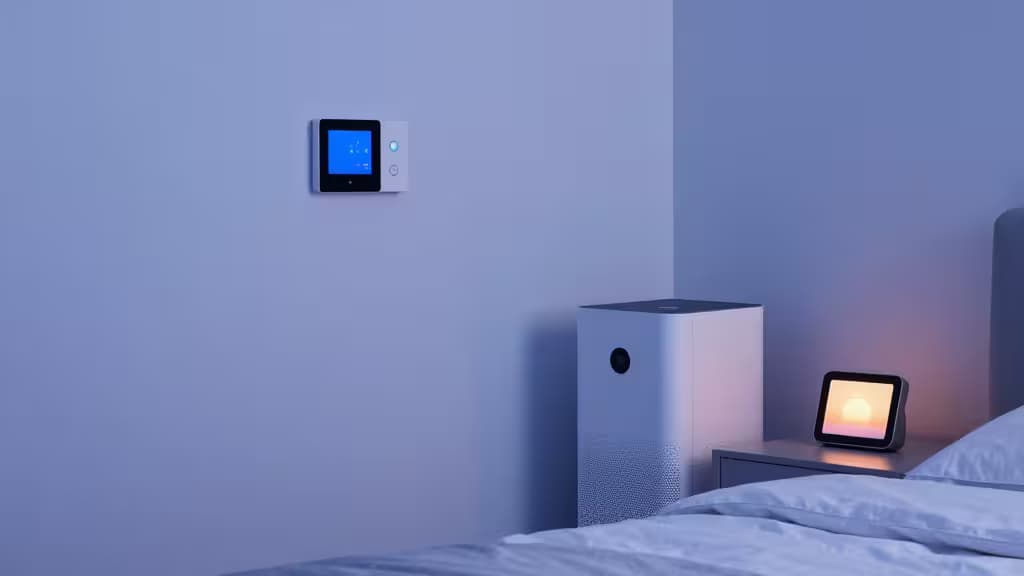
Poor sleep is often an environment problem, not a willpower problem. If you're tossing and turning at 2 a.m., the culprit is more likely a stuffy room, a thermostat set three degrees too high, or the absence of any wind-down ritual than a failure of discipline.
The Sleep Foundation identifies three environmental levers that matter most for restful sleep: air quality, bedroom temperature (ideally 60–67°F), and minimal noise1. Smart home devices can address all three — automatically, quietly, and without you fumbling for a switch in the dark. These are the things actually worth buying if your bedroom needs a technological intervention.
We tested and compared products across three sleep-critical categories: air purifiers that scrub allergens and VOCs while you sleep, a smart thermostat that keeps your bedroom in the thermal sweet spot, and voice-controlled hubs and displays that automate the whole wind-down routine. Here's what rose to the top.
Air Purifiers for Sleep
1. Levoit Vital 200S — Best Overall Air Purifier for Sleep
The Levoit Vital 200S hits the sweet spot of price, performance, and quiet operation that makes it our top pick for bedrooms. A laser air-quality sensor continuously monitors particulates and auto-adjusts fan speed — so if dust spikes while you're asleep, the purifier ramps up without you touching anything2. A dedicated sleep mode drops fan noise to a near-whisper, and the smartphone app lets you schedule purification cycles around your bedtime and wake time.
The carbon filter layer tackles VOCs and odors, which matters if your bedroom shares air with a kitchen or sits near a busy street. At roughly $140, it's the most budget-friendly pick in this guide and covers small-to-medium bedrooms comfortably2.
Why it wins: Smart auto-sensing, genuinely quiet sleep mode, and app scheduling at a price that doesn't require justification.
2. Blueair 311i Max — Best Quiet Air Purifier
For noise-sensitive sleepers — the kind who notice a fan's hum the way others notice a car alarm — the Blueair 311i Max is the upgrade pick. It carries Quiet Mark certification, meaning an independent body has verified its low noise output across operating modes3. Blueair's HEPA Silent technology combines mechanical and electrostatic filtration to move more air at lower sound levels than conventional HEPA-only designs.
The 311i Max is compact enough for medium bedrooms and includes app-based scheduling and geofencing, so it can ramp up when you leave the house and settle down by the time you're getting into bed3. It sits in the mid-range price band — more than the Levoit, but the noise reduction is real and measurable if you're a light sleeper.
Why it wins: Certified quiet operation and electrostatic-assisted filtration make it the pick for anyone who needs near-silence to sleep.
Smart Thermostat for Sleep
3. ecobee Smart Thermostat Premium — Best Smart Thermostat for Sleep
Temperature is the single most impactful environmental factor for sleep quality, and the ecobee Smart Thermostat Premium is the best tool we've found for managing it. The included remote SmartSensor is the key feature: place it in your bedroom, and the thermostat will condition based on that room's temperature rather than the hallway where the thermostat is mounted4. No more hot or cold spots while you sleep.
The Smart Thermostat Premium also includes a built-in air quality monitor — covering VOCs, humidity, and CO₂ — giving you a second environmental data point alongside temperature4. It works with Alexa, Google Home, and Apple HomeKit, so you can fold it into whichever ecosystem you already use for sleep routines. It sits in the premium price band, but the multi-zone capability alone justifies the cost if your bedroom runs hotter or colder than the rest of the house.
Why it wins: The remote bedroom sensor eliminates the most common thermostat complaint — "the bedroom is never the right temperature" — and the built-in air quality monitor is a genuine bonus.
Smart Displays and Hubs for Sleep Routines
4. Amazon Echo Show 8 (3rd Gen) — Best Smart Display for Sleep Routines
A smart display is the command center for a sleep-friendly bedroom. The Echo Show 8 (3rd Gen) supports visual sunrise-style alarms that gradually brighten the screen to simulate dawn, easing you awake instead of jolting you with a buzzer6. Bedtime routines can be fully automated: at a set time, the Show can dim the lights, start a white noise or sleep sounds skill, and display a darkened clock face that won't keep you awake.
The dimmable night screen is a small but important detail — many displays stay too bright in a dark room, and the Echo Show 8's adaptive brightness handles this well6. As an Alexa hub, it also controls the other devices in this guide: you can ask it to adjust the ecobee, check the Levoit's air quality reading, or trigger a "goodnight" scene that ties everything together.
Why it wins: Sunrise alarms, sleep sounds, and a properly dimmable screen make it the most sleep-aware smart display available.
5. Apple HomePod mini — Best Smart Hub for HomeKit Sleep Automation
If you live in an Apple household, the HomePod mini is the natural hub for sleep automation. It functions as a Thread Border Router with Matter support, meaning it can control a wide and growing range of smart home devices — including smart lights, locks, sensors, and thermostats — with reliable, low-latency local processing5. Siri handles voice commands for sleep scenes: "Hey Siri, goodnight" can trigger lights off, thermostat adjustment, and white noise in one phrase.
It's compact enough for a nightstand and sits at an affordable price point for a smart speaker, making it a low-risk entry into HomeKit sleep automation5. The audio quality is surprisingly good for its size, which means sleep sounds, podcasts, and ambient audio all sound better than you'd expect from something this small.
Why it wins: Thread/Matter future-proofing, Siri sleep scenes, and a budget-friendly price make it the best hub for Apple-centric homes.
How These Picks Work Together
The real power of a sleep-focused smart home isn't any single device — it's the combination. A sample "goodnight" routine might look like this:
- Echo Show 8 or HomePod mini triggers the routine at 10:30 p.m.
- ecobee drops the bedroom temperature to 65°F using the remote SmartSensor's reading.
- Levoit or Blueair shifts into sleep mode, maintaining air quality at whisper-quiet levels.
- Smart lights (controlled through the same hub) dim and turn off.
The next morning, the routine reverses: the thermostat eases back up, the air purifier ramps to full power, and the Echo Show's sunrise alarm gradually brightens the room. You wake up to cleaner air, a comfortable temperature, and simulated daylight — all automated.
How We Evaluated
We assessed each product on sleep-relevant criteria: noise output (critical for anything running in a bedroom), smart automation features (scheduling, sensors, voice control), ecosystem compatibility, and price. Product details were sourced from manufacturer specifications and official product pages2, with sleep environment guidance from the Sleep Foundation1.
Disclosure: Recomate may earn affiliate commissions from links in this guide. That doesn't influence our rankings — we pick what we'd actually put in our own bedrooms.