You don't need to rip out your garage door opener to make it smart. Retrofit controllers bolt onto your existing opener's motor unit and wire into the same terminals your wall button uses, adding app control, voice commands, scheduling, and — in some cases — hands-free automatic opening when your phone (or car) approaches1. The category's real differentiators aren't about opening and closing remotely (they all do that); they're about vehicle detection, multi-door support, and ecosystem compatibility.
We compared three options that take notably different approaches: a purpose-built garage controller, a future-proofed Matter hub, and a budget Zigbee alternative. Here's how they stack up.
How Retrofit Controllers Work
Every product here follows the same basic principle: it sends the same dry-contact signal your wall button does, just triggered by an app, a voice command, or an automation rule instead of a physical press. Installation typically takes 20–30 minutes and involves mounting the controller near your opener, connecting two wires to the opener's terminals, and pairing it with your home Wi-Fi1. The difference is what happens after that setup — and that's where these three diverge sharply.
1. Tailwind iQ3 — Top Pick
The Tailwind iQ3 is the only product in our lineup built specifically for garage doors, and it shows. Its standout feature is automatic vehicle detection: the controller uses Bluetooth to sense when your phone (or a paired vehicle) is approaching, and opens the door before you even reach the driveway1. No button press, no app tap, no fumbling with a remote. For anyone who's arrived home in the rain with a car full of groceries, that alone justifies the premium.
Beyond hands-free opening, the iQ3 supports multi-door control — you can wire it to manage up to three garage doors from a single controller, which is a meaningful cost advantage if you have a multi-bay garage1. It integrates with Amazon Alexa and Google Home for voice commands ("Alexa, close the garage"), and the app provides real-time status, scheduling, and alerts if the door is left open1.
What it doesn't offer: Apple HomeKit support and broader smart-home hub functionality. If your garage is just your garage, that's fine. If you want your garage door to trigger a whole-home "I'm home" scene involving lights, thermostat, and locks, you'll need a separate hub to coordinate.
Verdict: The best single purchase for most homeowners. Purpose-built garage features — especially automatic vehicle detection — make it the category standout.
2. Aqara Hub M3 — Runner-Up / Ecosystem Pick
The Aqara Hub M3 isn't a garage controller at all; it's a Matter controller with a Thread border router that can bridge Aqara's ecosystem of sensors and devices into a unified smart home2. To get garage functionality, you'd pair it with an Aqara garage door tilt sensor and an Aqara relay or smart plug to trigger the opener — a multi-piece setup that costs more and takes longer to configure than the Tailwind's all-in-one approach.
So why consider it? If you're already building (or planning) a Matter-based smart home, the M3 gives your garage door a seat at the table alongside every other connected device. Thread support means low-latency, mesh-reinforced communication, and Matter means cross-platform compatibility that should outlast any single ecosystem's proprietary protocol2. You get Alexa, Google Home, and HomeKit integration through the hub itself, and automations can tie your garage door to motion sensors, cameras, and lighting across the whole house.
The trade-off is clear: you're buying flexibility and future-proofing at the expense of out-of-the-box garage focus. There's no vehicle detection, no multi-door wiring, and no dedicated garage app experience.
Verdict: Best for users who want the garage integrated into a broader Matter smart home — not for someone who just wants their door to open when they pull up.
3. Aqara Hub M1S — Budget Alternative
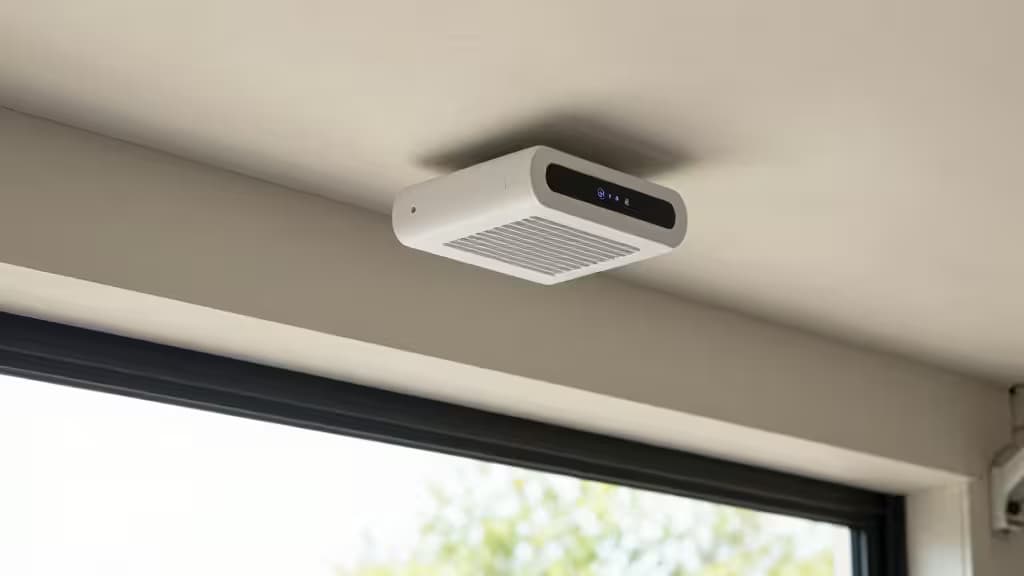
The Aqara Hub M1S is the entry-level option: a compact Zigbee hub with a built-in siren and Apple HomeKit support3. Like the M3, it requires a separate Aqara garage door tilt sensor to monitor and control your garage door, but the total package comes in at a lower price point than either the Tailwind iQ3 or the M3-plus-sensor combo.
The built-in siren is a nice touch for garage security — if the tilt sensor detects the door opening unexpectedly, the hub can sound an alarm and send a notification3. HomeKit support means Siri voice control and integration with Apple's Home app, which is a plus for iOS-centric households. Zigbee connectivity is reliable and low-power, though it lacks the Thread/Matter future-proofing of the M32.
The limitations mirror the M3's: no vehicle detection, no multi-door wiring, and you're buying a general-purpose hub rather than a garage-specific tool. But if you want basic smart garage monitoring and alerts on a budget — and especially if you're already in the Aqara ecosystem — the M1S gets the job done.
Verdict: The cost-effective route to smart garage security, especially for HomeKit users already invested in Aqara.
How They Compare
| Tailwind iQ3 | Aqara Hub M3 | Aqara Hub M1S |
|---|
| Vehicle Detection | Yes (Bluetooth auto-open) | No (requires sensor) | No (requires sensor) |
| Multi-Door | Yes (up to 3 doors) | Via sensors | Via sensors |
| Ecosystem | Alexa, Google Home | Matter, Thread, Alexa, Google Home, HomeKit | HomeKit, Alexa, Google Home |
The Tailwind iQ3 wins decisively on purpose-built garage features. The Aqara hubs win on broader smart-home integration and future-proofing — but you'll spend extra on sensors and accept a more complex setup to get there.
Which One Should You Buy?
For most homeowners: the Tailwind iQ3. Automatic vehicle detection and multi-door support are features no hub-plus-sensor combo can replicate, and the installation is genuinely simple. If your goal is "my garage door opens when I get home and I can check it from my phone," this is the one.
For smart-home enthusiasts: the Aqara Hub M3. If you're already running (or planning) a Matter ecosystem and want your garage door to participate in whole-home automations, the M3's Thread border router and cross-platform support make it the right foundation — just budget for a tilt sensor.
For budget-conscious HomeKit users: the Aqara Hub M1S. It delivers smart garage monitoring and alerts at a lower price, with the bonus of a built-in siren for security. Pair it with an Aqara tilt sensor and you're set.
Recomate may earn a commission when you purchase through links on this page. We recommend products based on independent editorial judgment, not affiliate placement.