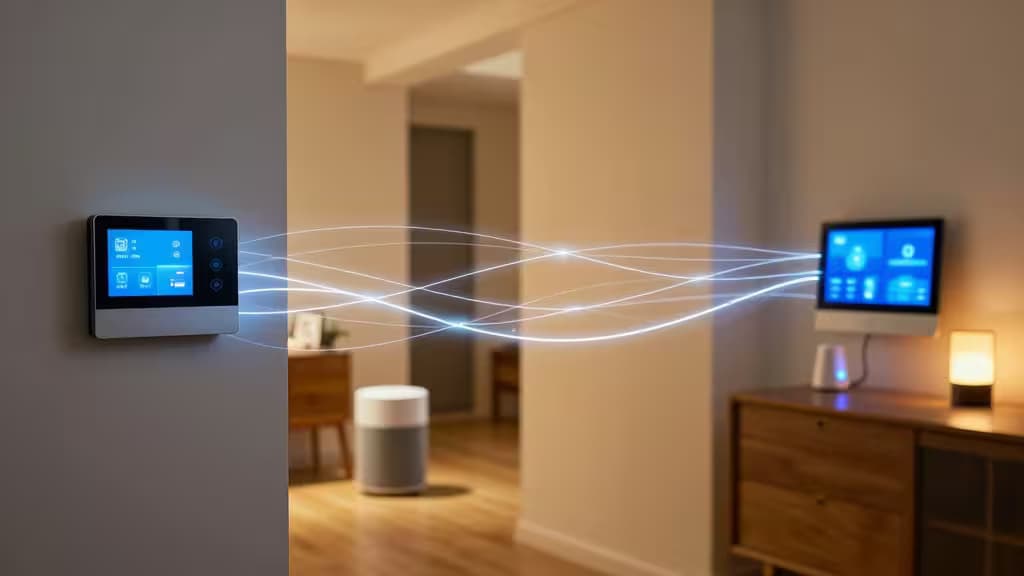
Matter was supposed to end the smart home platform wars. One universal standard, every device working with every assistant — no more checking compatibility charts before you buy a light bulb. The reality is a little messier. Matter does let a single device appear in Apple Home, Google Home, and Amazon Alexa simultaneously thanks to a feature called multi-admin, but you still need a hub that acts as both a Matter controller and a Thread Border Router to make that magic happen1.
The good news: 2026's hub landscape is genuinely better than it was even a year ago. Several devices now combine Matter controller functionality, Thread Border Router capability, and legacy protocol bridging (Zigbee, Z-Wave) into a single box. The question is no longer whether you can go cross-platform — it's which hub fits your household's mix of assistants, protocols, and budget.
Here's how we'd decide.
What Matters Most in a Cross-Platform Hub
Matter controller + Thread Border Router. These two capabilities are the non-negotiables. A Matter controller lets the hub commission and manage Matter devices; a Thread Border Router gives those devices a low-power, low-latency mesh network to ride on. Hubs missing either one limit your future-proofing1.
Multi-admin support. This is the feature that makes true cross-platform control possible. Multi-admin lets the same Matter device be controlled from Apple Home, Google Home, and Alexa at the same time — no choosing sides3.
Legacy protocol bridging. Not everything you own is Matter-ready yet. Zigbee and Z-Wave support lets a hub bridge older sensors and switches into the Matter world, extending cross-platform control to devices that were never designed for it5.
Local vs. cloud processing. Hubs that process automations locally (sometimes called "edge computing") keep working when your internet drops and generally respond faster. Cloud-dependent hubs are simpler to set up but go dark during outages6.
Our Picks
1. Aqara Hub M3 — Best Overall Cross-Platform Hub
If you want one device that does everything, this is it. The Aqara Hub M3 is a dedicated Matter controller and Thread Border Router and Zigbee coordinator and IR blaster, all in a single puck1. That combination is hard to find elsewhere — most hubs cover two or three of those protocols, not four.
What makes the M3 our top pick for cross-platform households is its explicit bridging of Aqara's extensive sensor lineup into Apple Home, Google Home, and Alexa simultaneously1. Edge computing handles automations locally, so your routines keep running even if your WAN connection drops1. The IR blaster is a bonus that lets you control older infrared-only devices (TVs, air conditioners) from any of the three major assistants.
The trade-off: it's a hub, not a speaker or display. You'll still want a voice assistant device in the room for hands-free commands. But as the brain of a mixed-ecosystem smart home, nothing else matches its protocol breadth.
2. Amazon Echo (4th Gen) — Best Budget All-in-One
The spherical Echo does double duty as a capable smart speaker and a surprisingly competent hub. It packs a built-in Zigbee radio, a Thread Border Router, and full Matter support2. At a mid-range price point, it's the most affordable way to get Matter + Thread + Zigbee in one device.
For cross-platform use, the Echo's strength is Alexa's willingness to play nice with Matter devices shared from other ecosystems. A smart lock commissioned through Apple Home can still be controlled by voice via Alexa, as long as multi-admin is enabled2. The downside is that Amazon's hub is cloud-centric — automations that depend on Alexa routines need an internet connection, and there's no Z-Wave or IR support.
If you're starting from scratch and want maximum bang for your buck, the Echo 4th Gen is the easiest entry point.
3. Apple HomePod mini — Best for Apple Home Households
The HomePod mini is the smallest, simplest Matter controller on this list. It's a compact smart speaker that doubles as a Thread Border Router for Apple Home3. At a mid-range price, it's an easy add to any room.
For households already invested in the Apple ecosystem, the HomePod mini is a no-brainer: it handles Matter device commissioning through the Home app, runs automations via HomeKit, and lets Siri control everything by voice. The cross-platform angle works through multi-admin — Matter devices managed by the HomePod mini can simultaneously appear in Google Home and Alexa apps3.
The limitation is Siri. If your household leans heavily on Google Assistant or Alexa for voice control, the HomePod mini is better suited as a secondary Matter controller and Thread Border Router rather than your primary voice interface.
4. Google Nest Hub Max — Best Smart Display
Some people want a screen. The Nest Hub Max is a high-end smart display with a built-in camera, Thread Border Router, and full Matter support4. It serves as a central command center for Google Home, with the added benefit of video calling, security camera feeds, and visual automations.
As a cross-platform hub, the Nest Hub Max shares Matter devices with Apple Home and Alexa via multi-admin, just like the other picks on this list4. The camera is a genuine differentiator — it can double as a Nest Cam for home monitoring, something no speaker-only hub can match.
The trade-off is price and protocol breadth. At the high end of the market, the Nest Hub Max supports Matter and Thread but lacks Zigbee and Z-Wave radios. If you have older Zigbee or Z-Wave devices, you'll need a separate coordinator.
5. Aeotec Smart Home Hub (SmartThings) — Best for Maximum Protocol Compatibility
If protocol compatibility is your top priority, the Aeotec Smart Home Hub — powered by Samsung SmartThings — is the most versatile option here. It supports Matter and Thread alongside both Zigbee and Z-Wave5. That's the widest protocol coverage of any hub in this lineup.
SmartThings is particularly strong at bridging disparate brands into a single automation platform, then exposing those devices to Alexa and Google Home5. Advanced routines let you create complex conditional automations that span multiple protocols and ecosystems. For households with a mix of old Z-Wave sensors, Zigbee bulbs, and new Matter devices, this is the hub that can tie it all together.
The downside: SmartThings is cloud-dependent for many functions, and the hub itself doesn't include a speaker or display. It's a pure-play hub for the protocol maximalist.
How They Compare
| Feature | Aqara Hub M3 | Echo 4th Gen | HomePod mini | Nest Hub Max | Aeotec (SmartThings) |
|---|
| Matter Controller | ✅ | ✅ | ✅ | ✅ | ✅ |
| Thread Border Router | ✅ | ✅ | ✅ | ✅ | ✅ |
| Zigbee | ✅ | ✅ |
Every hub on this list supports Matter and Thread — that's the baseline for inclusion. Where they diverge is in legacy protocol support, form factor, and processing model. The Aqara Hub M3 stands out for covering the most protocols (four) while offering local edge computing. The Aeotec hub is the only option with Z-Wave. The Echo, HomePod mini, and Nest Hub Max each trade protocol breadth for the convenience of a built-in voice interface.
The Bottom Line
For most mixed-ecosystem households, the Aqara Hub M3 is the strongest single choice — it's the only hub here that combines Matter, Thread, Zigbee, and IR with local processing, and it explicitly bridges into all three major assistant platforms1. If you'd rather have a voice assistant built in, the Amazon Echo (4th Gen) is the best value, and the HomePod mini is the natural pick for Apple-centric homes2. The Nest Hub Max adds a screen and camera for those who want visual control, and the Aeotec Smart Home Hub is the protocol maximalist's dream if Z-Wave compatibility is a must4.
Whatever you choose, make sure it has both Matter controller and Thread Border Router capability — those two features are what keep your smart home future-proof as the Matter standard continues to expand.
Recomate may earn a commission from links on this page. That doesn't influence our picks — we recommend the products we'd actually use.