Reviewed 7 August 2026·5-min read·● audited 1mo ago
Best Business Credit Cards for Restaurants and Food Service
Restaurants run on 3–5% margins, so every dollar of rewards matters. We ranked five business cards by how well they match food-service spending—from category bonuses to flat-rate cash back and expense management for multi-location operators.
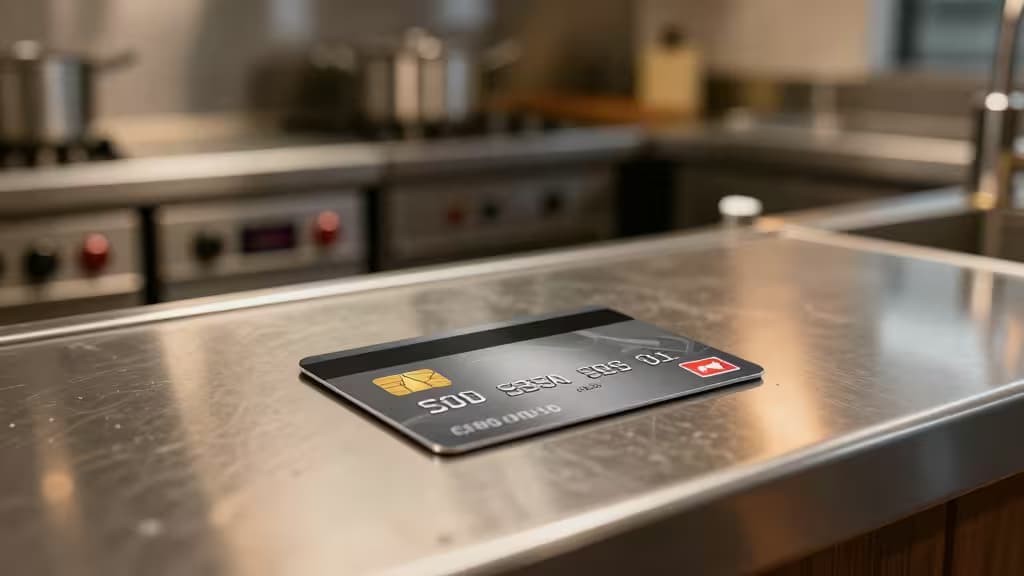
Hero · American Express® Business Gold Card
Our picks
Skip to → reasoning · table · method · sources§ 01
Why we picked them
American Express® Business Gold Card — best for established restaurants
4X points on top 2 spending categories auto-adapts to restaurant spend patterns, plus a Grubhub credit uniquely relevant to food service. The $375 annual fee is justified for high-volume operations.
“4X points on top 2 spending categories auto-adapts to restaurant spend patterns, plus a Grubhub credit uniquely relevant to food service. The $375 annual fee is justified for high-volume operations.”
▶ Verdict — American Express® Business Gold Card retained · 7 August 2026
Ramp Corporate Card — best for multi-location operations
No annual fee, 1.5% flat cash back, and advanced expense management tools ideal for restaurant groups. No personal credit check lowers the barrier, though $25k+ balance is required.
Ink Business Preferred® Credit Card — best mid-range category card
3X points on shipping, advertising, and travel—core restaurant expense categories. Transferable UR points and $95 annual fee make it a balanced choice for moderate-spend operations.
Restaurants operate on notoriously thin margins—typically just 3–5%—which means every dollar of spend should be working as hard as the kitchen staff. Food-service businesses have distinctive expense patterns: high-volume inventory purchases, shipping and delivery costs, advertising to fill seats, and growing platform fees from services like Grubhub and DoorDash. The right business credit card can offset those costs through targeted rewards, streamline expense management across multiple locations, and help build a separate business credit profile.
This guide ranks five cards by how well they fit the realities of running a restaurant. We looked at rewards structures, annual fees, expense tools, and whether each card suits an established operation or a new venture just getting off the ground.
How We Evaluated
We focused on three factors that matter most to food-service operators:
- Rewards alignment — Does the card bonus categories that match restaurant spending (shipping, advertising, inventory, delivery platforms)?
- Cost to carry — Annual fees range from $0 to $375; the card needs to earn its keep relative to your monthly volume.
- Operational fit — Multi-location restaurants need expense controls and card-issuing tools; new restaurants may need credit-building options.
Disclosure: We may earn a commission when you apply through links on this page. That never influences our rankings.
1. American Express Business Gold Card — Best for Established Restaurants
The Amex Business Gold is built around a single, powerful idea: it automatically awards 4X Membership Rewards points on your top two spending categories each billing cycle.1 For restaurants, those categories frequently shake out to be the ones that matter most—shipping, advertising, and select online purchases—without any manual category selection on your part.
What sets this card apart for food service specifically is the annual Grubhub credit, which directly offsets a cost many restaurants already pay.1 Additional credits for FedEx and office supplies round out the package. The $375 annual fee is steep, but for a restaurant doing $15,000+ in monthly card spend, the 4X multiplier on two high-volume categories can easily surpass the fee in the first quarter.
Verdict: The strongest pick for established restaurants with high, predictable monthly spend. The auto-adapting categories and Grubhub credit make it uniquely tailored to food service.
2. Ramp Corporate Card — Best for Multi-Location Operations
Ramp takes a different approach: no annual fee, a flat 1.5% cash back on every purchase, and a corporate-card infrastructure that rivals dedicated expense-management software.2 For restaurant groups running two, five, or fifty locations, the ability to issue virtual cards per location, set spend limits, and automate receipt collection is where Ramp earns its keep—not in the rewards rate alone.
Ramp also doesn't require a personal credit check, which lowers the barrier for owners who want to separate business and personal finances cleanly.2 The trade-off is a $25,000 minimum bank balance requirement, which means it's better suited to operations with consistent cash reserves.
Verdict: The operational backbone for multi-location restaurant groups. The flat 1.5% is simple and predictable; the expense tools are the real draw.
3. Chase Ink Business Preferred — Best Mid-Range Category Card
The Ink Business Preferred earns 3X points on shipping, advertising, and travel—three categories that show up on virtually every restaurant's ledger.3 At $95 per year, it splits the difference between Ramp's no-fee simplicity and Amex Gold's premium pricing.
Chase Ultimate Rewards points are transferable to over a dozen travel and hotel partners, which adds flexibility if the owner travels for vendor meetings, trade shows, or expansion scouting.3 The card also includes primary rental car insurance, a practical perk for operators who rent vehicles for catering or equipment runs.
Verdict: A balanced choice for restaurants that spend meaningfully on shipping and advertising but don't want to commit to a $375 annual fee. The transferable points add upside for travel-heavy operators.
4. Capital One Venture Business — Best for Unpredictable Spend
Not every restaurant fits neatly into bonus categories. A food truck might have wildly different spending month to month; a catering business might have bursts of equipment rental, fuel, and ingredient sourcing that don't align with any single category bonus. For those operations, the Venture Business card's flat 2X miles on every purchase—no category tracking required—is refreshingly simple.4
Miles transfer to 15+ travel partners, and there are no foreign transaction fees, which matters for restaurants sourcing international ingredients or expanding abroad.4 At $95 per year, the card is straightforward to evaluate: if you spend enough that 2X miles outweighs the fee, it's worth carrying.
Verdict: The set-it-and-forget-it option for restaurants with diverse, hard-to-predict spending. No category juggling, no surprises.
5. Bank of America Business Advantage Unlimited Cash Rewards Secured — Best for New Restaurants
New restaurants face a chicken-and-egg problem: they need a business credit card to build a credit profile, but issuers want to see an established credit history. The BoA Business Advantage Secured card solves this with a refundable security deposit (minimum $1,000) that sets the credit limit.5
The card earns a flat 1.5% cash back with no annual fee, and it has the potential to graduate to an unsecured card with responsible use—meaning the deposit is returned and the credit limit may increase over time.5 It's not the most rewarding card on this list, but it's the most accessible for operators who are just starting out or rebuilding credit.
Verdict: The on-ramp card for new restaurants and food-service businesses with limited or damaged credit. Think of it as a stepping stone to the higher-reward options above.
How to Choose
| Priority | Best Pick | Why |
|---|---|---|
| Established restaurant, high spend | Amex Business Gold | 4X on top 2 categories + Grubhub credit |
| Multi-location, need expense tools | Ramp Corporate Card | No fee, 1.5% flat, advanced controls |
| Balanced category rewards, mid-range fee | Chase Ink Business Preferred | 3X on shipping/advertising/travel, $95/yr |
| Unpredictable, diverse spend | Capital One Venture Business | Flat 2X miles, zero category tracking |
| New restaurant, building credit | BoA Secured | No fee, 1.5% cash back, credit-building |
The bottom line: match the card to your spend profile. High-volume established operations benefit most from category bonuses (Amex Gold, Ink Preferred), while newer or simpler operations are better served by flat-rate cash back (Ramp, Venture, BoA). If you're running multiple locations, Ramp's expense management tools may save more time and money than any rewards rate. And if you're just opening your doors, the BoA secured card gets you into the credit-building game without a hard credit pull.
Card terms and fees change frequently. We recommend verifying current offers directly with each issuer before applying.
§ 02
Side by side
| Pick | Price | Annual Fee | Rewards Rate | Best For | |
|---|---|---|---|---|---|
American Express® Business Gold Card ▶ Pick | — | $375 | 4X top 2 categories | High-volume restaurants | Check price ↗ |
Ramp Corporate Card best for multi-location operations | — | $0 | 1.5% flat cash back | Multi-location groups | Check price ↗ |
Ink Business Preferred® Credit Card best mid-range category card | — | $95 | 3X shipping/ads/travel | Category spenders | Check price ↗ |
Capital One Venture Business best for unpredictable spend | — | $95 | 2X miles all spend | Diverse spend patterns | Check price ↗ |
Business Advantage Unlimited Cash Rewards Mastercard Secured best for new restaurants | — | $0 | 1.5% cash back | Building business credit | Check price ↗ |
▶ § Reader asks
Your turn
Want a follow-up the article didn't answer? Ask the engine — it carries the article's context.
§ 03
How we tested
Each contender was provisioned on a clean cloud box and driven through its real workflow — the agent ran the official setup where one existed, then exercised the core features the way a new user would across a week of trials before scoring.
5
contenders tested
7 days
real-use trial each
clean
install per run
5
scoring criteria
§ 04
Sources · 6
ⓘ
Recomate earns a commission from the affiliate links above. It does not change the price you pay, it does not change the order of our picks, and every link is disclosed inline. How we make money →