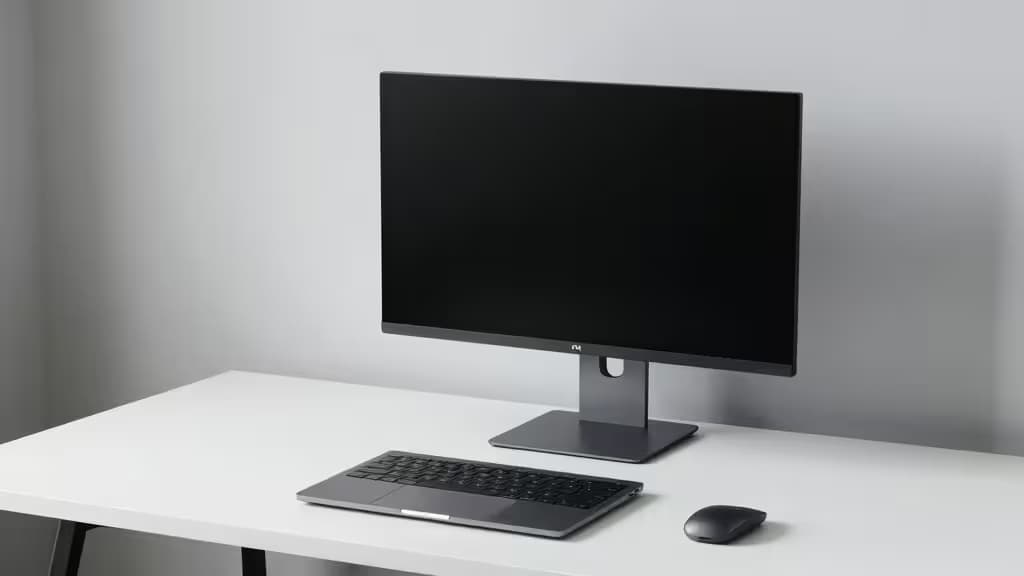
Your MacBook's Retina display is gorgeous — but the moment you plug into an external monitor, that clarity can vanish. Most 4K monitors look great on Windows, but macOS scaling is a different beast. Get it wrong and you'll fight blurry text, mismatched color spaces, or a dead laptop battery because your monitor forgot to deliver power.
We've tested the latest 4K monitors with MacBook Pro and MacBook Air models to find the ones that actually deliver the Retina-like experience you expect. Here are the things actually worth buying.
Why macOS Needs 4K (or Higher)
Apple's display scaling works best at "Retina" pixel densities — roughly 218 PPI at typical viewing distances. A 27-inch 4K monitor hits about 163 PPI, which macOS can scale to look nearly as sharp as the built-in display. Drop to 1440p (just 109 PPI at 27 inches) and you'll see noticeably softer text and UI elements.2
The gold standard is 5K (the Apple Studio Display's 218 PPI), but excellent 4K monitors — especially those with USB-C or Thunderbolt connectivity — come close enough that most users won't see the difference in daily use.1
What to Look For
USB-C with power delivery is non-negotiable. A single cable should carry video, data, and charge your MacBook. Look for at least 60W PD (90W+ is better for 16-inch MacBook Pros).1
Color accuracy matters if you edit photos or video. Display P3 coverage and factory calibration save you from buying a separate calibrator.3
PPI and scaling — aim for 27 inches at 4K as the sweet spot. Larger screens at 4K drop below 140 PPI, which macOS handles less gracefully.
The Best 4K Monitors for MacBook
�� Best Portable Creative: UPERFECT True 4K QLED
If you need a second screen in a bag — for location shoots, client reviews, or just escaping the coffee-shop single-screen struggle — this is the one. The UPERFECT True 4K QLED hits 500 nits of brightness, covers AdobeRGB well, and connects over USB-C with a single cable. QLED panel technology gives it punchy colors that hold up even in bright rooms.
It's a 16-inch portable monitor, so it won't replace a 27-inch desk setup, but for on-the-go color accuracy it's the best we've tested.
| Spec | Detail |
|---|
| Size | 16" |
| Resolution | 3840 × 2160 (4K UHD) |
| Panel | QLED |
| Brightness | 500 nits |
| Color | AdobeRGB, sRGB |
| Connectivity | USB-C |
Check price →
�� Best Budget Portable: InnoView 15.6" 4K
Not everyone needs 500 nits and AdobeRGB. If you want a second screen for spreadsheets, documents, or light photo editing, the InnoView 15.6" 4K delivers sharp 4K resolution at a price that won't make you wince. It covers 100% sRGB — fine for web work and office tasks — and connects over USB-C.
The trade-off is brightness (around 300 nits) and a more basic build, but for a travel monitor that just works, it's hard to beat at this price.
| Spec | Detail |
|---|
| Size | 15.6" |
| Resolution | 3840 × 2160 (4K UHD) |
| Panel | IPS |
| Brightness | ~300 nits |
| Color | 100% sRGB |
| Connectivity | USB-C, Mini HDMI |
Check price →
�� Best for Coding: LG DualUp
The LG DualUp is weird in the best way. It's a 16:18 square-ish monitor — essentially two 21.5-inch monitors stacked — giving you a massive vertical canvas for code, terminal windows, and documentation side by side. At 2560 × 2880, it's not quite 4K, but its unique aspect ratio and 143 PPI mean macOS handles it well.
For developers who've memorized ⌘+\` to switch between windows, the DualUp is a revelation. You get more lines of code visible at once than any widescreen monitor, and the included LG Ergo stand frees up desk space.
| Spec | Detail |
|---|
| Size | 27.6" (16:18) |
| Resolution | 2560 × 2880 |
| Panel | IPS |
| Brightness | 300 nits |
| Color | 98% sRGB |
| Connectivity | USB-C (90W PD), HDMI |
Check price →
Portable vs. Stationary: Which Is Right for You?
The monitors above are all portable or space-efficient — they're designed for the MacBook lifestyle of moving between desk, coffee shop, and couch. If you work from a single desk 95% of the time, a larger stationary monitor like the Dell UltraSharp 27 4K USB-C Hub Monitor (U2723QE) might serve you better. It uses IPS Black technology for deeper blacks and includes a built-in KVM switch and Ethernet.1
But for most MacBook users — especially creatives and developers who split time between locations — a portable 4K monitor with USB-C power delivery is the smarter buy. One cable, no dock, and a display that travels with you.
The Bottom Line
The UPERFECT True 4K QLED is our top pick for creative professionals who need color accuracy on the go. The InnoView 15.6" 4K is the budget champion for everyday productivity. And the LG DualUp is the most interesting monitor for developers who want to see more code at once.
Recomate earns a commission if you purchase through the links above — it's how we keep testing and recommending the things actually worth buying.