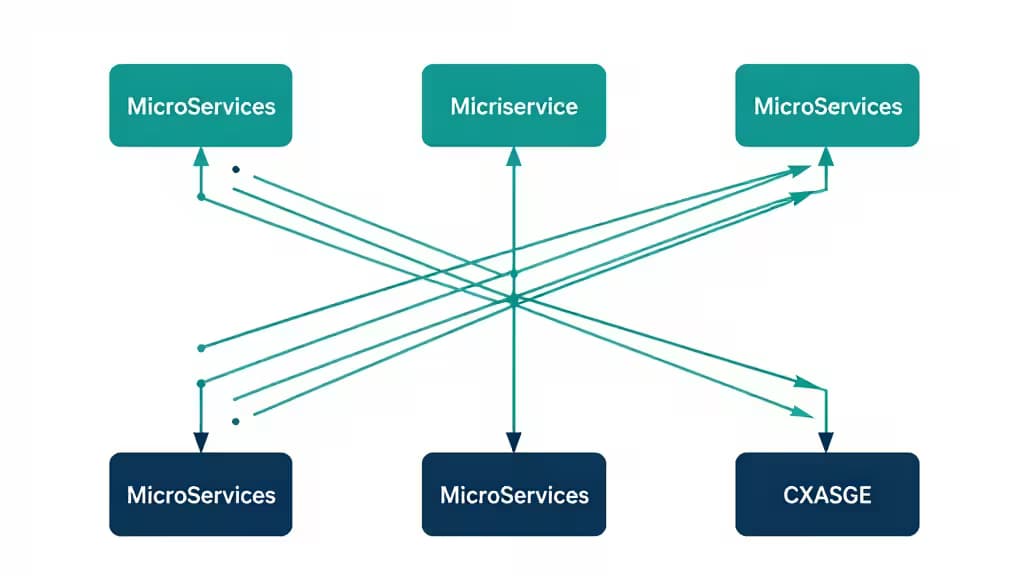
The monitoring gap in distributed systems
If your application is a monolith, a single uptime check tells you most of what you need. But the moment you decompose into microservices, a simple "is it up?" ping becomes nearly useless. A slow downstream service can cascade into timeouts across your entire graph, and without distributed tracing you're left guessing which node failed first.1
The good news: you don't need a six-figure Datadog contract to get real observability. We combed the current landscape for tools that give small teams the things actually worth buying — genuine microservices insight for under $100/month.
What to look for in a microservices monitoring tool
Basic uptime monitors check one endpoint every few minutes. For microservices, that's like checking whether the front door is locked while the kitchen is on fire. You need three things:
- Distributed tracing — follow a single request across service boundaries1
- Error-rate and latency dashboards — per service, not per endpoint3
- Affordable pricing — scales with a small team, not an enterprise procurement cycle
Every pick below delivers at least two of these three.
The best API monitoring tools for microservices
1. Uptrace — Best open-source APM for distributed tracing
Uptrace is an open-source application performance monitoring platform built specifically for distributed tracing. It ingests OpenTelemetry data, visualizes service maps, and surfaces slow spans — all without a per-host license fee. For teams willing to self-host on their own infrastructure, the cost is effectively zero beyond your compute time. The trade-off: you own the operational overhead of running the collector and database.1
Best for: Teams that need full distributed tracing and have DevOps chops to self-host.
2. Postman — Best for API development and testing workflows
Postman has evolved far beyond a REST client. Its monitoring module lets you schedule collection runs against your microservices endpoints, assert response shapes, and alert on failures. The paid plan starts at $12 per user per month, making it one of the cheapest ways to get structured API testing integrated with your development pipeline.2 It is less about deep tracing and more about functional correctness, but for teams that already live in Postman, the workflow integration is unmatched.
Best for: Development teams that want monitoring tightly coupled with their API design workflow.
3. New Relic — Best full-stack observability free tier
New Relic free tier includes 100 GB of data ingestion per month, which goes a surprisingly long way for a small microservices deployment. You get distributed tracing, error analytics, and APM dashboards out of the box. Paid plans start at $25 per month when you need more capacity.3 The catch: the UI can feel overwhelming, and the free tier data retention is limited. But for a team that wants one pane of glass without paying enterprise prices, it is hard to beat.
Best for: Teams that want a full SaaS observability stack with a generous free allowance.
4. UptimeRobot — Best budget option for endpoint monitoring
UptimeRobot Pro plan starts at just $7 per month and gives you 50 monitors with 1-minute intervals, plus SSL certificate checks and status pages. It will not give you distributed traces, but for teams that need reliable uptime and latency alerts on their API endpoints without any fuss, it is the most cost-effective option on this list.3 Think of it as your first line of defense, the smoke alarm, not the fire investigation team.
Best for: Budget-conscious teams that need reliable endpoint uptime monitoring.
5. Uptime Kuma — Best self-hosted open-source dashboard
Uptime Kuma is a gorgeous, self-hosted uptime monitor with a built-in status page. It supports HTTP, TCP, ping, and DNS checks, and it sends notifications via Telegram, Slack, email, and dozens of other channels. Zero monthly cost, full data sovereignty, and a Docker image that deploys in seconds.1 Like Uptrace, you trade operational overhead for price, but for a team with a spare container slot, it is a no-brainer companion to a deeper APM tool.
Best for: Teams that want a free, beautiful status page with full data control.
Comparison table
| Tool | Starting Price | Key Microservices Feature | Hosting Model |
|---|
| Uptrace | Free (self-host) | Distributed tracing via OpenTelemetry | Self-hosted |
| Postman | $12/user/mo | Scheduled collection tests and assertions | SaaS |
| New Relic | Free (100 GB/mo) | Full-stack APM plus distributed tracing | SaaS |
| UptimeRobot | $7/mo | 1-min interval endpoint monitoring |
Why these tools hit the sweet spot
The common thread: every tool here delivers meaningful microservices observability, not just "is it up?", at a price point that does not require a CFO sign-off. Whether you self-host Uptrace for zero monthly cost or pay $7 per month for UptimeRobot Pro plan, you are getting the features that actually matter for distributed systems: latency tracking, error-rate visibility, and the ability to trace requests across service boundaries.
Sources
- 10 Best API Monitoring Tools in 2025 — Uptrace
- Top API Monitoring Tools — EdgeDelta
- 11 Best Uptime Monitoring Tools — UptimeRobot