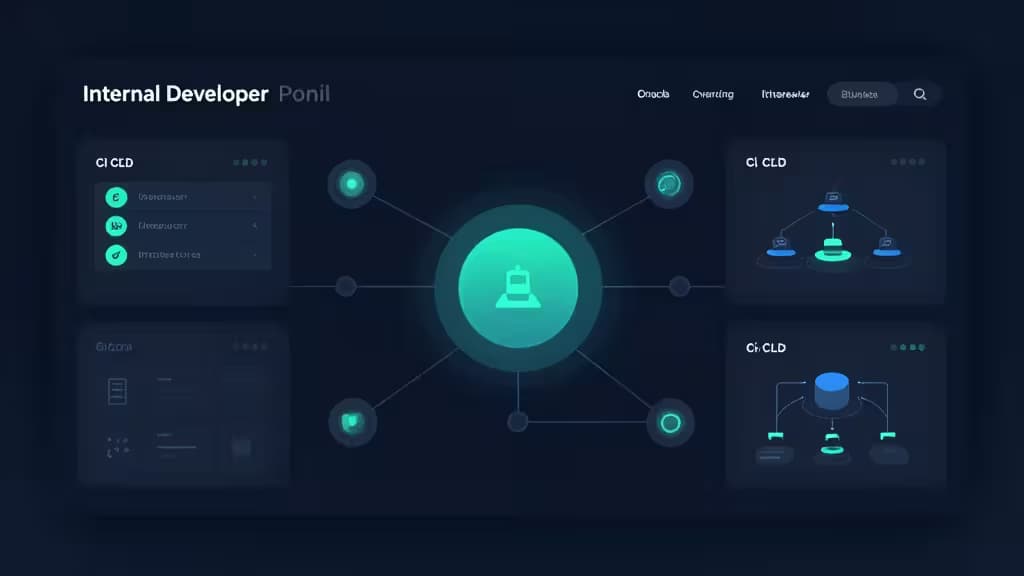
Backstage — Spotify's open-source framework for building developer portals, now a CNCF project — has become the default reference architecture for internal developer portals (IDPs). It offers a service catalog, software templates, and tech docs in a single React-based app1. But anyone who has deployed it knows the catch: Backstage is a framework, not a product. You write custom React plugins, wrangle YAML-heavy configuration, and maintain a build pipeline just to keep the portal running. There's no built-in UI for non-engineers, and the plugin ecosystem — while large — means every integration is a maintenance commitment.
Teams seeking a simpler or more managed path to an IDP have strong alternatives. The right choice depends on what you actually need Backstage for: a unified DevOps platform, GitOps-native continuous delivery, an API-centric portal, or an infrastructure control plane. Here's how the landscape breaks down.
1. GitLab Self-Managed — The All-in-One Replacement
If your Backstage portal mostly serves to catalog services and provide CI/CD templates, GitLab Self-Managed may already cover 80% of what you need without a separate framework. GitLab unifies source code management, CI/CD pipelines, a container registry, and Auto DevOps templates in a single self-hosted application3. The built-in project and group hierarchy functions as a lightweight service catalog, and Auto DevOps provides opinionated templates that replace Backstage's software templates for common workflows.
The trade-off is extensibility. Where Backstage lets you build bespoke React plugins for any internal tool, GitLab's integration model is more constrained — you work within its webhook, API, and CI/CD extension points. For teams that want a unified platform rather than a build-your-own portal, that constraint is a feature, not a bug.
Best for: Teams that want SCM, CI/CD, registry, and service discovery in one self-hosted platform — and don't need a custom plugin ecosystem.
2. Harness — The Managed Enterprise Option
Harness positions itself as an AI-driven continuous delivery platform, but its service inventory, governance, and automated rollback features overlap significantly with what teams build in Backstage4. The key difference: Harness is a managed SaaS. There's no React framework to maintain, no plugin pipeline to operate, and no YAML configuration sprawl. You get enterprise-grade deployment orchestration with built-in canary analysis, automated rollbacks, and policy-as-code governance out of the box.
Managed IDP platforms like Harness trade Backstage's extensibility for time-to-value — a recurring theme in the alternatives landscape2. The cost is vendor lock-in and per-seat or per-pipeline pricing rather than the free, self-hosted model of Backstage. For large organizations that need portal-plus-delivery without dedicating a platform team to maintaining a Backstage instance, that's often a worthwhile exchange.
Best for: Enterprise teams that want a managed portal-and-delivery platform with governance and AI-driven deployment automation — no framework maintenance required.
3. Argo CD — The GitOps-Native Complement
Argo CD, a CNCF-graduated project, takes a different approach: rather than building a portal UI, it makes Git the single source of truth for application deployment5. Teams define desired application state in Git repositories, and Argo CD continuously syncs that state to Kubernetes clusters. This declarative, GitOps model replaces the deployment workflows that Backstage's software templates typically handle — but without the React plugin overhead.
Argo CD isn't a full portal. There's no service catalog, no tech docs, no scaffolding wizard. But many teams pair it with a lightweight catalog (or even a simple static site) and find they've covered their actual needs without the operational burden of a full Backstage deployment. If your team is already invested in Kubernetes and GitOps practices, Argo CD is the natural complement.
Best for: Kubernetes-native teams that want self-service, declarative deployments via GitOps — and are willing to pair Argo CD with a lightweight catalog.
4. Crossplane — The Infrastructure Control Plane
Crossplane, maintained by Upbound as a CNCF project, rethinks self-service infrastructure provisioning6. Instead of Backstage's software templates — which generate scaffolding code and Terraform or Helm files — Crossplane turns a Kubernetes cluster into a control plane where developers provision cloud resources via custom resource definitions (CRDs). Want an S3 bucket or a Postgres instance? Apply a YAML manifest, and Crossplane handles the rest.
This is a fundamentally different model: infrastructure-as-code through Kubernetes-native APIs rather than portal-driven forms. Platform teams define composed resources (XRDs) that abstract away provider complexity, and developers consume them with simple CRDs. The trade-off is that Crossplane addresses only the infrastructure-provisioning slice of what Backstage does — there's no service catalog, no docs, no CI/CD integration. But for teams whose primary Backstage use case is self-service infra templates, Crossplane is a more robust, declarative alternative.
Best for: Platform teams that want developers to provision infrastructure via Kubernetes CRDs instead of portal forms — a deeper, more declarative take on self-service.
5. Azure API Management — The API-Centric Portal
Not every team needs Backstage's full service-catalog breadth. For organizations whose primary goal is publishing, securing, and discovering APIs, Azure API Management includes a built-in developer portal that's turnkey and managed2. Developers can browse API documentation, request access keys, and test endpoints through a customizable portal — no React plugins required.
This is a narrower scope than Backstage, focused exclusively on the API layer. But for API-first organizations or teams that have already standardized on Azure, it eliminates the need to build and maintain a custom portal for API discovery. The portal is auto-generated from your API definitions and can be branded and customized without writing code.
Best for: API-centric organizations on Azure that need a turnkey developer portal for API discovery, documentation, and access management — without Backstage's full-scope overhead.
How to Choose
The decision comes down to what you're actually using Backstage for, and how much maintenance overhead your team can absorb:
| Need | Best Pick | Why |
|---|
| Unified SCM + CI/CD + catalog | GitLab Self-Managed | All-in-one platform, no separate framework |
| Managed enterprise portal + delivery | Harness | SaaS, AI-driven CD, governance built in |
| GitOps-native deployments | Argo CD | Declarative, CNCF-graduated, Kubernetes-native |
| Self-service infrastructure | Crossplane | Kubernetes CRDs replace portal forms |
| API discovery and publishing |
Backstage's greatest strength — its plugin extensibility — is also its greatest cost. Every alternative here trades some of that flexibility for faster time-to-value, simpler operations, or a more focused feature set. The question isn't which tool is "best" in the abstract; it's which one matches your team's actual workflow and maintenance budget.
Disclosure: We may earn a commission from links in this article, at no cost to you. Our recommendations are editorial and based on independent assessment.